
Geometric Measure of 2 with Construction Protocol
Loading the math board and drawing, please wait…
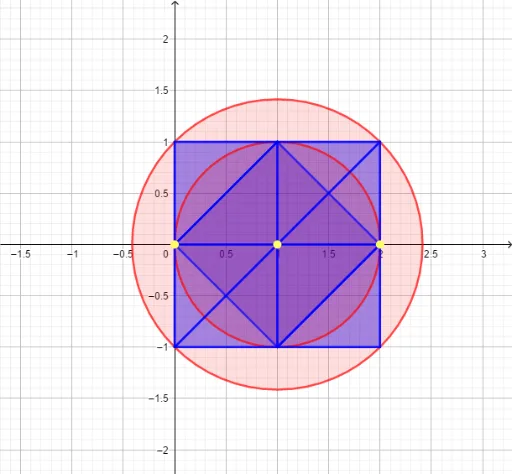
This example visualizes a musical measure of 2 through geometric reduction, transforming rhythmic duration into a structured geometric figure. It demonstrates how geometric constructions can represent abstract concepts like time or beat. Core mathematical concepts include geometric construction, similarity transformations, symmetry, midpoints, and angle bisectors, with implicit connections to trigonometric functions and probability. The construction uses GeoGebra commands such as Circle, Segment, OrthogonalLine, Intersect, Polygon, Mirror, Midpoint, and LineBisector, creating numerous objects (B, C, A, D, E, q1, a, d1, etc.) and their mirrored or transformed counterparts, resulting in a complex symmetric pattern. This is suitable for middle school and above, offering an interdisciplinary approach linking geometry and music, and serves as an advanced exercise in geometric construction and transformation.
GeoGebra Commands & Parameters
Circle(B, C) → cSegment(A, C) → fOrthogonalLine(B, Segment[A, C]) → gIntersect(c, g, 2) → DIntersect(c, g, 1) → ESegment(D, E) → hPolygon(A, D_{1}, C, E_{1}) → q1, a, d_{1}, c_1, e_{1}Polygon(A, B, D_{1}) → t1, i, a_1, bMirror(A, B) → A'Mirror(B, B) → B'Mirror(D_{1}, B) → FPolygon(A', B', F) → t1', f_1, a', b'Midpoint(i) → GMidpoint(a_1) → HMirror(A, G_{1}) → A'_1Mirror(B, G_{1}) → B'_1Mirror(D_{1}, G_{1}) → IPolygon(A'_1, B'_1, I) → t1'_1, i_1, a'_1, b'_1Mirror(A, H_{1}) → A'_2Mirror(B, H_{1}) → B'_2Mirror(D_{1}, H_{1}) → JPolygon(A'_2, B'_2, J) → t1'_2, j, a'_2, b'_2Segment(I, A'_2) → kLineBisector(Segment[I, A'_2]) → lIntersect(e_{1}, b'_1) → KIntersect(l, a) → LIntersect(d_{1}, b'_2) → MIntersect(l, c_1) → NMirror(A'_1, K_{1}) → OMirror(B'_1, K_{1}) → PMirror(I, K_{1}) → I'Polygon(O, P, I') → t2, i', o, pMirror(A', N_{1}) → A''Mirror(B', N_{1}) → B''Mirror(F, N_{1}) → F'Polygon(A'', B'', F') → t1'', f', a'', b''Mirror(A, L_{1}) → A'_3Mirror(B, L_{1}) → B'_3Mirror(D_{1}, L_{1}) → QPolygon(A'_3, B'_3, Q) → t1'_3, q, a'_3, b'_3Mirror(A'_2, M_{1}) → RMirror(B'_2, M_{1}) → SMirror(J, M_{1}) → J'Polygon(R, S, J') → t3, j', r, sSegment(B'_3, B'') → mPolygon(B'_3, A'_2, B'', I) → q2, n, t, d, i_2Circle(B, I) → e
AI Drawing Prompt Reference
Start with a circle and a diameter segment. Construct a line through the circle's center perpendicular to the diameter, intersecting the circle at two points, forming an inscribed quadrilateral. Build triangles using the center and diameter endpoints, then mirror them across the diameter to create symmetric counterparts. Take midpoints of triangle sides and use each as a center to mirror the original triangle, producing nested symmetric triangles. Further mirror triangles using intersections of angle bisectors with sides, generating additional small triangles. Finally, connect key points with segments and draw a circle centered at the original center passing through a mirrored point, resulting in a highly symmetric geometric pattern.
The prompt above was compiled from the original drawing commands and is for reference only.