
Normal Distribution and Table Demo
Loading the math board and drawing, please wait…
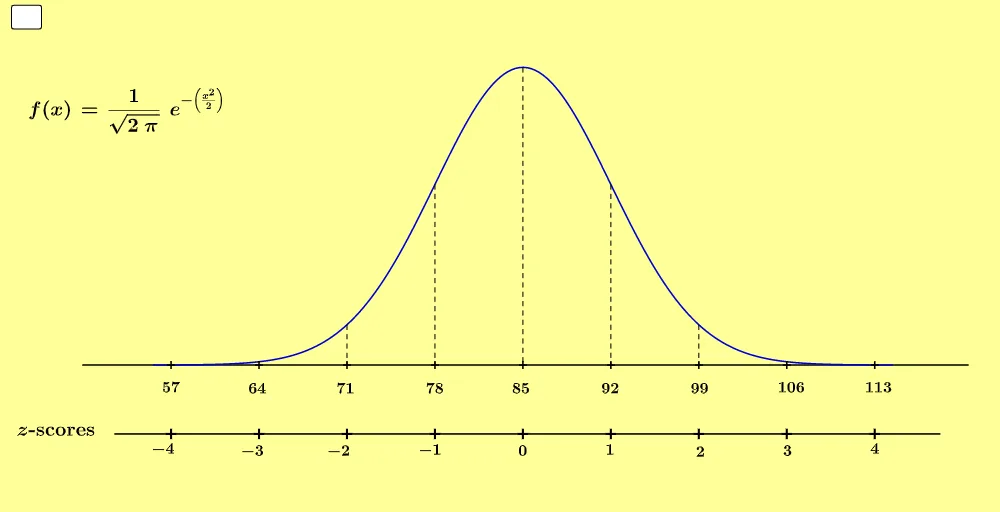
This example demonstrates the graphical representation of the normal distribution curve and its probability density function. Core math concepts include normal distribution, probability & statistics, and differential calculus involving integrals and derivatives. GeoGebra commands and objects used are Point, Random, Textfield, Intersect, Integral, OrthogonalLine, Segment, LaTeX, Vector. Suitable for high school students and math enthusiasts to learn and understand the properties and calculations of the normal distribution.
GeoGebra Commands & Parameters
Point(xAxis) → KRandom(5, 20) → iiPoint(xAxis) → NPoint(xAxis) → MPoint(xAxis) → ITextfield(σ) → InputBox1Textfield(μ) → InputBox2Intersect(b, k) → UIntersect(xAxis, b) → VIntegral(f, x(M), x(N)) → oIntersect(xAxis, k) → F_1Point(k) → R_1Point(k) → S_1OrthogonalLine(K, k) → iIntersect(i, k) → LOrthogonalLine(B, k) → mOrthogonalLine(C, k) → nOrthogonalLine(E, k) → pOrthogonalLine(A, k) → qOrthogonalLine(D, k) → rOrthogonalLine(FF, k) → sOrthogonalLine(G, k) → tOrthogonalLine(H, k) → f_1OrthogonalLine(J, k) → g_1Intersect(g_1, k) → OIntersect(f_1, k) → PIntersect(t, k) → QIntersect(s, k) → RIntersect(r, k) → SIntersect(q, k) → TIntersect(m, k) → WIntersect(n, k) → ZIntersect(p, k) → A_1Intersect(f, t, (-2, 0.05399096651318806)) → B_1Intersect(f, s, (-1, 0.24197072451914337)) → C_1Intersect(f, r, (0, 0.3989422804014327)) → D_1Intersect(f, q, (1, 0.24197072451914337)) → E_1Intersect(f, m, (2, 0.05399096651318806)) → G_1Intersect(f, n, (3, 0.004431848411938008)) → H_1Intersect(f, f_1, (-3, 0.004431848411938008)) → I_1Segment(C_1, FF) → h_1Segment(D_1, D) → i_1Segment(E_1, A) → j_1Segment(G_1, B) → k_1Segment(B_1, G) → l_1Point(k) → J_1Point(k) → K_1Segment(J_1, K_1) → m_1Textfield(v) → InputBox3Point(f) → L_1Point(f) → M_1Segment(L_1, M_1) → n_1LaTeX(f, true, true) → text48Intersect(p_1, n_1) → N_1Intersect(p_1, m_1) → O_1Vector(N_1, O_1) → u_1OrthogonalLine(I, m_1) → q_1Intersect(q_1, m_1) → P_1Vector(I, P_1) → v_1Vector(K, L) → w_1OrthogonalLine(N, m_1) → r_1OrthogonalLine(M, m_1) → s_1Intersect(r_1, m_1) → Q_1Intersect(s_1, m_1) → T_1Vector(N, Q_1) → a_1Vector(M, T_1) → b_1Integral(f, x(K), 4.5, false) → jIntegral(f, -4.5, x(I), false) → e