
Nigde - Ak madrassa: Geometric Construction and Function Analysis
Loading the math board and drawing, please wait…
In collections
Fatin Uluengin - muqarnas
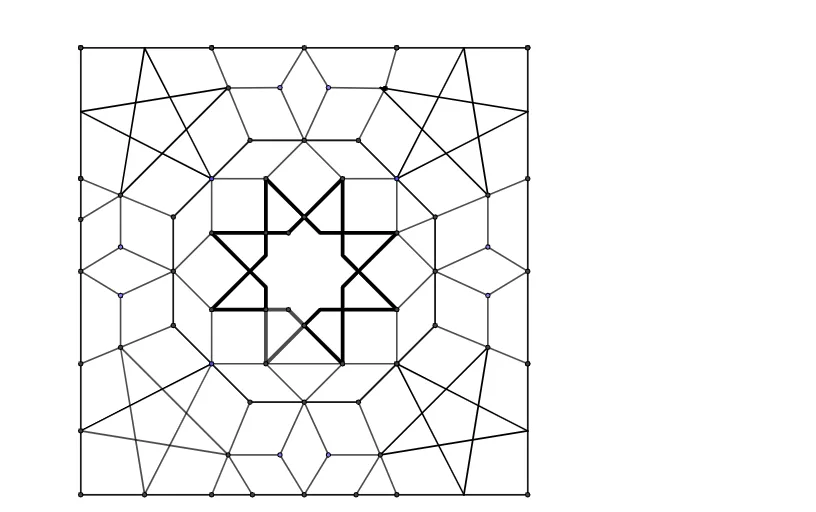
This example demonstrates the analysis of function graphs through geometric construction. Key mathematical concepts include trigonometry, coordinate geometry, and geometric construction. The construction involves using GeoGebra commands like Intersect, Polygon, and Rotate to build triangles, circles, and loci. Suitable for high school students or college freshmen learning the application of geometry and functions.
GeoGebra Commands & Parameters
Intersect(xAxis, yAxis) → AConstructionStep() → stapPolygon(E, B, C, D) → vierhoek1, e, b, c, dSegment(E, C) → fSegment(D, B) → gIntersect(d, yAxis) → FIntersect(b, yAxis) → GSegment(F, G) → hIntersect(e, xAxis) → HIntersect(c, xAxis) → ISegment(H, I) → iRotate(I, 22.5°) → I'Ray(A, I') → jIntersect(c, j) → JSegment(A, J) → kSequence(Segment[Rotate[A, (nn * 90°)], Rotate[J, (nn * 90°)]], nn, 1, 3) → l1Mirror(A, xAxis) → A'Mirror(J, xAxis) → J'Segment(A', J') → k'Sequence(Segment[Rotate[A', (nn * 90°)], Rotate[J', (nn * 90°)]], nn, 1, 3) → l2Rotate(J, 90°) → J'_1Mirror(J'_1, yAxis) → KMirror(J, yAxis) → J'_2Mirror(J', yAxis) → J''Mirror(J'_1, xAxis) → LMirror(K, xAxis) → K'Segment(J'_1, L) → lSegment(K, K') → mSegment(J'_2, J) → nSegment(J'', J') → pSegment(J'', K) → qSegment(L, J) → rSegment(J'_1, J') → sSegment(J'_2, K') → tIntersect(h, q) → MIntersect(n, q) → NIntersect(f, n) → OIntersect(h, r) → PIntersect(p, t) → QIntersect(g, l) → RPolygon(R, L, P, Q) → vierhoek2, r_1, l_1, p_1, q_1Sequence(Polygon[Rotate[R, (nn * 45°)], Rotate[L, (nn * 45°)], Rotate[P, (nn * 45°)], Rotate[Q, (nn * 45°)]], nn, 1, 7) → l3Segment(J'', L) → aLine(B, C) → f_1Line(J'', J) → g_1Intersect(f_1, g_1) → SLine(S, yAxis) → h_1Polygon(B, S, 4) → veelhoek1, i_1, j_1, k_1, m_1, T, ULine(J'_1, J'_2) → n_1Line(J, K) → s_1Line(B, E) → t_1Intersect(s_1, t_1) → VLine(C, D) → a_1Mirror(S, yAxis) → S'Mirror(T, yAxis) → T'Polygon(T, T', 4) → veelhoek2, b_1, c_1, d_1, e_1, W, ZMirror(S, xAxis) → S'_1Intersect(n_1, a_1) → A_1Intersect(g_1, c_1) → B_1Intersect(a_1, b_1) → C_1Polygon(S'_1, E, 4) → veelhoek3, f_2, g_2, h_2, i_2, D_1, E_1Polygon(D, B_1, 4) → veelhoek4, j_2, k_2, l_2, m_2, F_1, G_1Polygon(C_1, T', 4) → veelhoek5, n_2, p_2, q_2, r_2, H_1, I_1Segment(S, B_1) → s_2Segment(S'_1, S') → t_2Segment(S'_1, C_1) → a_2Segment(C_1, V) → b_2Segment(S, A_1) → c_2Segment(A_1, U) → d_2Segment(U, B_1) → e_2Intersect(e_1, xAxis) → J_1Intersect(c_1, xAxis) → K_1Segment(J_1, K_1) → f_3Intersect(d_1, yAxis) → L_1Intersect(b_1, yAxis) → M_1Segment(L_1, M_1) → g_3Segment(V, S') → h_3Intersect(a_2, c_2) → N_1Line(N_1, g_3) → i_3Intersect(i_3, s_2) → O_1Intersect(i_3, t_2) → P_1Polygon(P_1, O_1, 8) → veelhoek6, j_3, R_1, S_1, T_1, U_1, V_1, k_3, l_3, m_3, n_3, p_3, q_3, r_3, Q_1Segment(Z, T') → s_3Segment(W, T) → t_3Segment(S, U) → a_3Intersect(t_3, a_3) → W_1Rotate(W_1, (-(60°)), B) → Z_1Rotate(W_1, 60°, B) → A_2CircleArc(B, Z_1, A_2) → c_3Intersect(c_3, s_2, 1) → B_2Intersect(c_3, d_2, 1) → C_2Rotate(B, (-(120°)), B_2) → B'CircleArc(B_2, B', B) → d_3Rotate(B, 120°, C_2) → B'_1CircleArc(C_2, B, B'_1) → e_3Intersect(j_1, e_1) → D_2Intersect(j_1, e_1) → E_2Intersect(d_3, Segment[S, T]) → F_2,Intersect(k_1, b_1) → G_2Intersect(k_1, b_1) → H_2Intersect(b_1, n_2) → I_2Intersect(e_3, Segment[T', T]) → J_2,Segment(F_2, B) → b_3Segment(F_2, C_2) → f_4Segment(B, J_2) → g_4Segment(J_2, B_2) → h_4Segment(B_2, C_2) → i_4Sequence(Rotate[l4, (nn * 90°)], nn, 1, 3) → l5Line(N_1, s_2) → j_4Line(B_2, g_3) → k_4Line(C_2, q_2) → l_4Line(C_2, b_1) → m_4Point(m_4) → K_2Intersect(a_2, e_2) → L_2Mirror(K_2, g_3) → M_2Polygon(L_2, K_2, M_1, M_2) → vierhoek3, n_4, p_4, q_4, r_4Line(C_2, p_4) → s_4Intersect(s_4, b_1) → N_2Mirror(N_2, g_3) → O_2Segment(C_2, N_2) → t_4Mirror(C_2, g_3) → P_2Segment(C_2, K_2) → a_4Segment(M_2, P_2) → b_4Segment(P_2, O_2) → c_4Segment(L_2, K') → d_4Segment(Q_1, U) → e_4Rotate(C_2, (-(90°))) → R_2Rotate(N_2, (-(90°))) → S_2Segment(R_2, S_2) → f_5Rotate(U, (-(90°))) → U'Rotate(K_2, (-(90°))) → T_2Rotate(M_2, (-(90°))) → U_2Segment(J_1, T_2) → g_5Segment(J_1, U_2) → h_5Segment(T_2, N_1) → i_5Segment(U_2, N_1) → j_5Segment(R_2, T_2) → k_5Segment(U_2, B_2) → l_5Segment(L, L_2) → m_5Mirror(K_2, f_3) → V_2Mirror(M_2, f_3) → W_2Intersect(c_2, h_3) → Z_2Polygon(L_1, V_2, Z_2, W_2) → vierhoek4, n_5, v_2, z_2, w_2Point(b_2) → A_3Segment(A_3, V_2) → p_5Point(l5) → B_3Segment(W_2, B_3) → q_5Segment(B_3, U_1) → r_5Segment(J'_1, Z_2) → s_5Segment(Z_2, K) → t_5Segment(K, D) → a_5Segment(E, J'_1) → b_5Segment(V, V_1) → c_5Segment(B_3, A_1) → d_5Intersect(q_5, d_5) → C_3Segment(U_1, C_3) → e_5Mirror(T_2, yAxis) → D_3Mirror(U_2, yAxis) → E_3Mirror(N_1, yAxis) → F_3Segment(D_3, K_1) → f_6Segment(D_3, F_3) → g_6Segment(F_3, E_3) → h_6Segment(E_3, K_1) → i_6Mirror(R_2, yAxis) → G_3Mirror(B_2, yAxis) → H_3Segment(G_3, D_3) → j_6Segment(E_3, H_3) → k_6Segment(S'_1, J'_2) → l_6Segment(S, J'') → m_6Segment(J', S') → n_6Segment(J, B_1) → p_6Segment(R_1, P_2) → q_6Segment(P_2, C_1) → r_6Segment(D, J) → s_6Segment(N_1, J'_2) → t_6Segment(N_1, J'') → a_6Segment(J'_2, E) → b_6Segment(J, F_3) → c_6Segment(F_3, J') → d_6Segment(S_1, S') → e_6Segment(J', C) → f_7Segment(J'', B) → g_7Segment(S, O_1) → h_7Segment(S'_1, P_1) → i_7
AI Drawing Prompt Reference
This is a geometric construction example based on coordinate geometry. The figure consists of the intersection of the coordinate axes, a quadrilateral formed by the axes and segments, triangles generated through rotation and reflection, and trajectories formed by these shapes. The construction order is to first determine the intersection of the axes, then build the quadrilateral, followed by generating other shapes via rotation and reflection, and finally forming polygons and trajectories. Suitable for students learning geometry and functions.
The prompt above was compiled from the original drawing commands and is for reference only.