
Network and Surface Area of a Triangular Prism
Loading the math board and drawing, please wait…
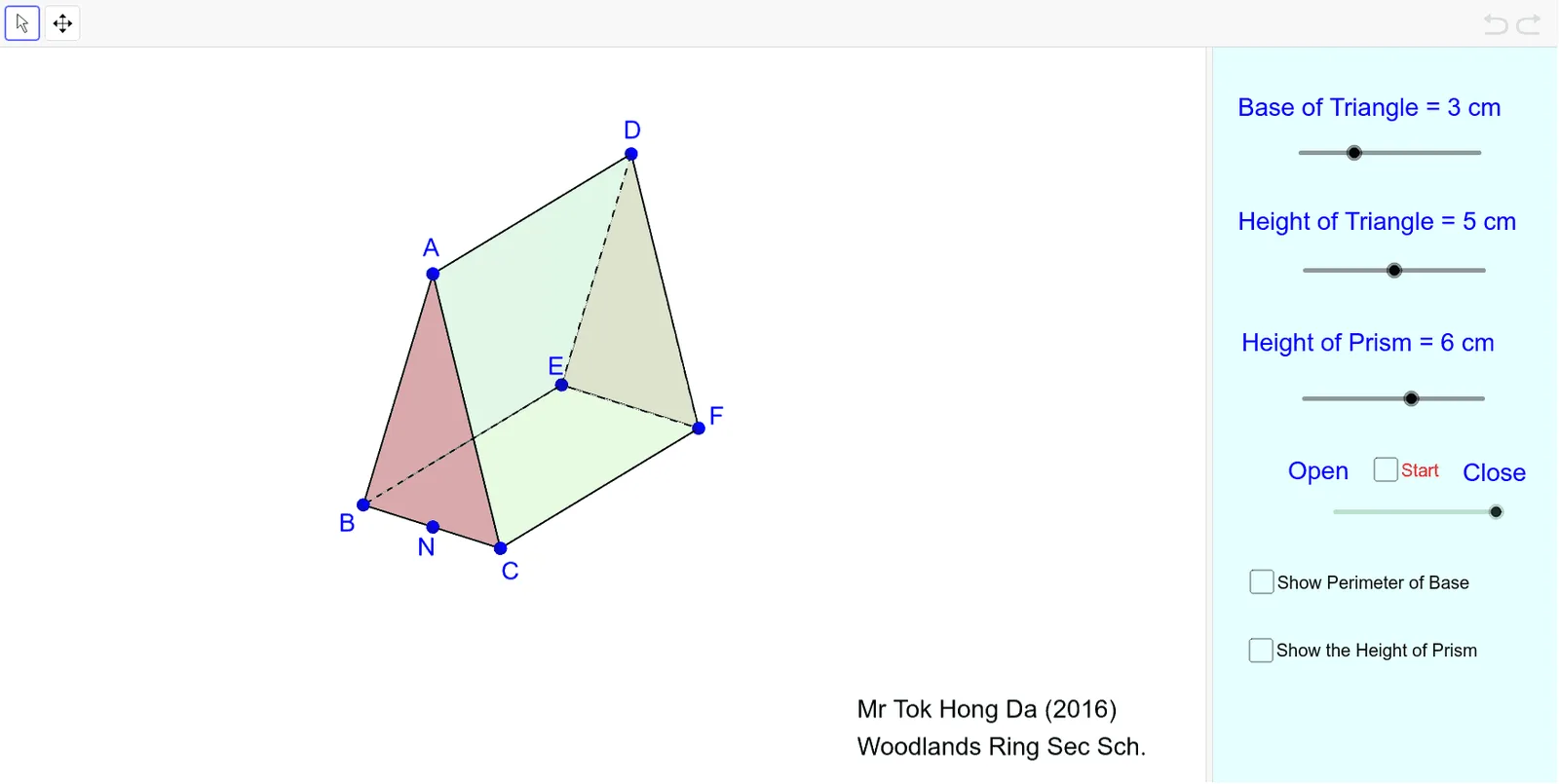
This example demonstrates how to calculate the network length and surface area of a triangular prism. A triangular prism is a three-dimensional solid formed by two congruent triangular bases and three rectangular lateral faces. The key mathematical concepts involved include geometric volume calculation, solving quadratic equations, and locating special points. Construction points include using GeoGebra commands such as Segment, Point, Distance, Polygon, Intersect, and Midpoint to construct the prism's components. Suitable for middle or high school students learning solid geometry and quadratic equations.
GeoGebra Commands & Parameters
Segment(B, C) → fPoint(f) → N_1Distance(B, N_1) → BNDistance(N_1, B) → NBDistance(N_1, C) → NCPolygon(A, B, E, D) → poly1, a, b_1, e, dPolygon(G, C, F, H) → poly2, g, c, f_1, h_1Polygon(I, B, C) → poly3, c_1, i, b_2Polygon(J, F, E) → poly4, e_1, j, f_2Polygon(B, E, F, C) → poly5, b_3, e_2, f_3, c_2Segment(A, B) → kSegment(B, C) → lSegment(G, C) → mSegment(D, E) → nIntersect(b_1, n) → KSegment(E, F) → pSegment(F, H) → qMidpoint(h_1) → LPolygon(M, N, O, P) → poly6, m_1, n_1, o_1, p_1
AI Drawing Prompt Reference
Draw a net of a triangular prism, consisting of two congruent triangular bases and three rectangular lateral faces. Start by drawing one side of a base triangle and mark a point on it, measuring distances from this point to the two endpoints. Then construct the two triangular bases and four rectangles, where two rectangles serve as lateral faces and the other two as additional unfolded faces. Connect the intersection point between a base edge and a side, and locate the midpoint of one edge. Finally, form a quadrilateral with four points to represent the overall unfolded outline. The figure should clearly show the edge lengths and geometric relationships needed for calculating surface area.
The prompt above was compiled from the original drawing commands and is for reference only.