
Nets of Solids
Loading the math board and drawing, please wait…
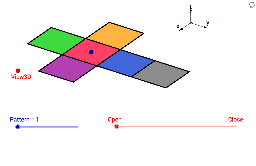
This GeoGebra example demonstrates the construction and dynamic visualization of nets of solids (such as prisms and pyramids), showing how a 3D solid's surface unfolds into a flat polygon net. It illustrates the transition between a three-dimensional solid and its two-dimensional net through rotation and translation. Core mathematical concepts include solid geometry, surface area, nets, 3D-to-2D projection, and geometric transformations such as translation, reflection, and rotation. The construction uses GeoGebra commands including Vector, Translate, OrthogonalLine, Polygon, Midpoint, Segment, and Mirror, along with 3D view (View3D) and parameters like sinphi, cosphi, sintheta, costheta to control viewing angles)Skip. This resource is suitable for middle and high school geometry classes, helping students understand how solid surfaces are composed and how they unfold, and is ideal for interactive math exploration and classroom demonstrations.
GeoGebra Commands & Parameters
Vector(B_1, Z) → wVector(B_1, Y) → vVector(B_1, X) → uTranslate(A, Vector[(2 * v)]) → A'Translate(P, Vector[(2 * v)]) → P'OrthogonalLine(View3D, yAxis) → a_1OrthogonalLine(View3D, xAxis) → b_1Polygon(L, K, N, M) → poly1, l, k_1, n, mPolygon(K, P, Q, N) → poly2, k_2, p, q, n_1Polygon(L, M, S, R) → poly3, l_1, m_1, s, rPolygon(N, V, W, M) → poly4, n_2, v_1, w_1, m_2Polygon(K, T, U, L) → poly5, k_3, t, u_1, l_2Polygon(B, Q, P, A) → poly6, b_2, q_1, p_1, a_2Midpoint(R, M) → DTranslate(S, Vector[(-((2 * v)))]) → S'Segment(S, C) → eTranslate(M, Vector[(-2 * v)]) → M'Segment(M, E) → fSegment(E, C) → hTranslate(N, Vector[(-2 * v)]) → N'Translate(Q, Vector[(-2 * v)]) → Q'_1Segment(Q, F) → iSegment(N, G) → jSegment(G, F) → d_1Translate(Q, Vector[(-2 * v)]) → Q'_2Translate(B, Vector[(-2 * v)]) → B'_1Segment(B, I) → e_1Segment(I, H) → f_1Segment(H, Q) → g_1Translate(K, Vector[(2 * v)]) → K'Translate(P, Vector[(2 * v)]) → P'_1Segment(P, J) → h_1Segment(J, A_1) → i_1Segment(A_1, K) → j_1Segment(B, H_1) → s_1Segment(H_1, C_1) → cSegment(C_1, A) → r_1Midpoint(N, P) → D_1Midpoint(k_1) → F_1Segment(A, G_1) → t_1Segment(G_1, I_1) → c_2Segment(I_1, P) → d_2Segment(J, K_1) → f_2Segment(P, L_1) → e_2Segment(L_1, K_1) → g_2Segment(M, W) → h_2Mirror(L_1, F_1) → O_1Mirror(K_1, F_1) → P_1Segment(M, M_1) → i_2Segment(N_1, J_1) → j_2Segment(J_1, M_1) → p_2Polygon(M, E, C, S) → poly7, q_2, r_2, s_2, t_2Polygon(Q, N, G, F) → poly8, q_3, n_3, g_3, f_3Polygon(B, Q, H, I) → poly9, b_3, q_4, h_3, i_3Polygon(J, A_1, K, P) → poly10, j_3, a_3, k_4, p_3Polygon(C_1, A, B, H_1) → poly11, c_3, a_4, b_4, h_4Polygon(G_1, I_1, P, A) → poly12, g_4, i_4, p_4, a_5Polygon(K_1, J, P, L_1) → poly13, k_5, j_4, p_5, l_3Polygon(M, M_1, J_1, N_1) → poly14, m_3, m_4, j_5, n_4
AI Drawing Prompt Reference
Create a 3D prism and its corresponding 2D net, showing how the solid's surface unfolds into a flat polygon net. The prism has multiple faces (base and lateral sides) colored distinctly, and the net is laid out flat with connected edges. Include auxiliary segments, midpoints, and mirrored shapes to illustrate geometric transformations during unfolding. The composition should clearly show the correspondence between the 3D solid and its 2D net, with key vertices and edges labeled.
The prompt above was compiled from the original drawing commands and is for reference only.