
Net of Pyramid - Dynamic GeoGebra Demonstration
Loading the math board and drawing, please wait…
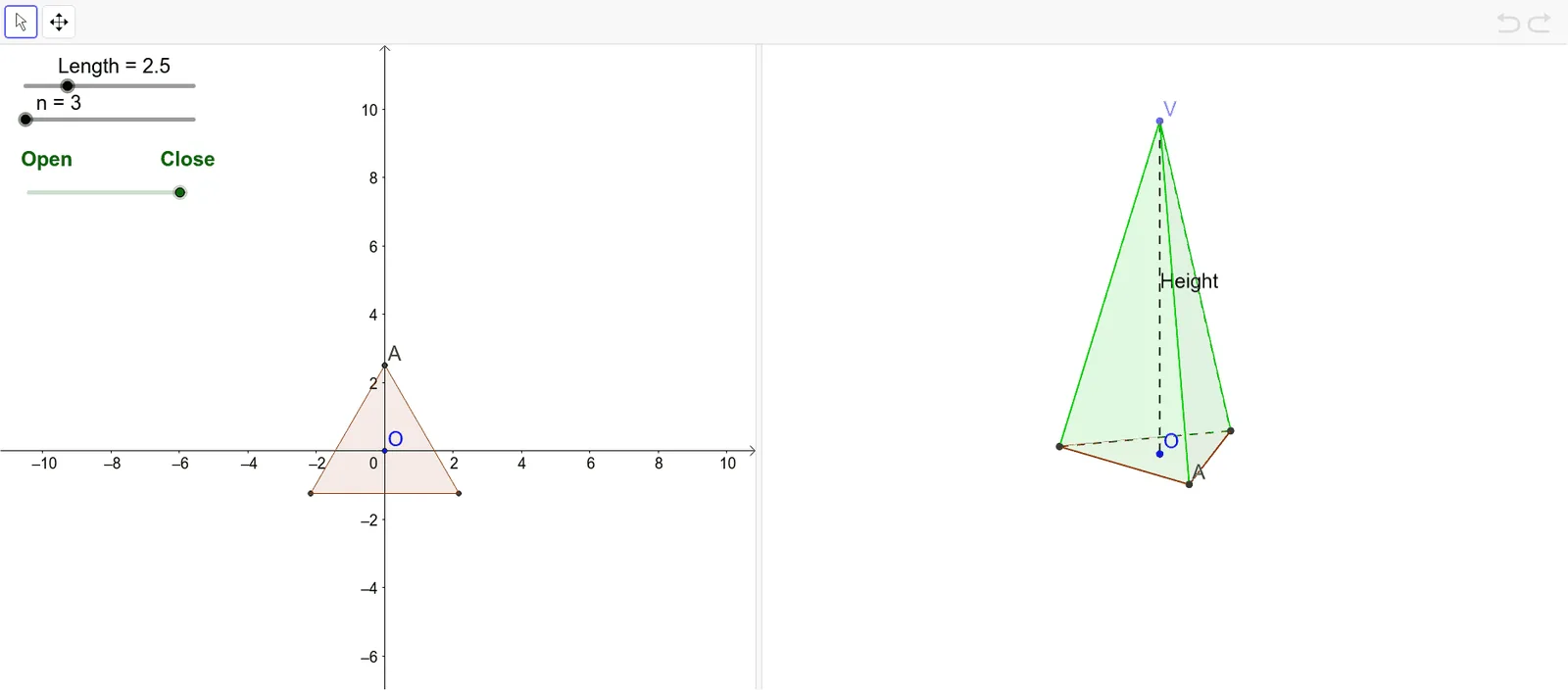
① This GeoGebra example dynamically demonstrates the net of a pyramid, showing how a 3D solid is unfolded into a 2D planar polygon arrangement. ② Core mathematical concepts include solid geometry (pyramid structure), nets, polygons, segments, vertices, edge lengths, slant heights, and angle relationships, along with sequences for generating vertices and polygons for constructing lateral faces and base. ③ Construction highlights: from the summary, commands such as Sequence, Polygon, Line, Point, Segment, Vector, LineBisector, Intersect, UnitVector, and Circle are used; objects like Length, A, O, n, Vertices, Polygon, a, V, Height, SlantEdge, Z, angle, ReferencePerpendicularBisector, ReferenceIntersectionPoint, ReferenceVector, ReferenceUnitVector, ReferenceIndividualAngle, ReferenceAllUnitVector, c, d, B, C, FlattenLength, AllVertices, poly1, b, e, f, poly2, g, h, i, AllTriangles, FinalTriangle, j, k, l, text1, and text2 are defined to compute the flattened positions and labels. ④ Suitable for middle and high school geometry classes, this resource helps students visualize the unfolding and folding of pyramids, enhancing spatial reasoning and supporting hands-on exploration or math labs.
GeoGebra Commands & Parameters
Sequence(Rotate[A, ((360 * ° / n) * k), O], k, 0, n - 1, 1) → VerticesPolygon(Vertices) → PolygonLine(O, zAxis) → aPoint(a) → VSegment(O, V) → HeightSegment(A, V) → SlantEdgeVector((0, 0, 1)) → ZLineBisector(Element[Vertices, 1], Element[Vertices, 2]) → ReferencePerpendicularBisectorIntersect(ReferencePerpendicularBisector, Line[Element[Vertices, 1], Element[Vertices, 2]]) → ReferenceIntersectionPointVector(O, ReferenceIntersectionPoint) → ReferenceVectorUnitVector(ReferenceVector) → ReferenceUnitVectorSequence(Vector[Rotate[ReferenceUnitVector, ((360 * ° / n) * k), O]], k, 0, n - 1, 1) → ReferenceAllUnitVectorCircle(Element[Vertices, 1], SlantEdge) → cCircle(Element[Vertices, 2], SlantEdge) → dIntersect(c, d) → B, C, ,Segment(O, C) → FlattenLengthSequence(O + ((FlattenLength * cos(angle)) * Element[ReferenceAllUnitVector, k]) + ((Height * sin(angle)) * Z), k, 1, n, 1) → AllVerticesPolygon(Element[Vertices, 1], Element[AllVertices, 1], Element[Vertices, 2]) → poly1, b, e, fPolygon(Element[Vertices, 2], Element[AllVertices, 2], Element[Vertices, 3]) → poly2, g, h, iSequence(Polygon[Element[Vertices, k], Element[AllVertices, k], Element[Vertices, k + 1]], k, 1, n - 1, 1) → AllTrianglesPolygon(Element[Vertices, n], Element[AllVertices, n], Element[Vertices, 1]) → FinalTriangle, j, k, l