
Net of Pyramid - Dynamic 3D to 2D Unfolding
Loading the math board and drawing, please wait…
In collections
Mathematics Form 2
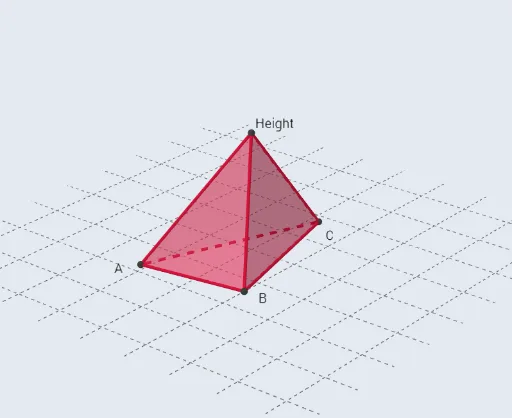
This GeoGebra example demonstrates the net (unfolding) of a pyramid, showing how a 3D solid is transformed into a flat 2D arrangement of polygonal faces. The core mathematical concepts include solid geometry, pyramid structure, nets, polygonal faces, edges, and the relationship between 3D shapes and their 2D developments. The construction uses GeoGebra commands such as SelectedIndex, If, Point, Net, and Sequence, along with objects like vertices (A, B, C, D, etc.), faces (face1 to face5), and edges (edge1 to edge12). A slider or index-based control likely drives the unfolding animation, allowing step-by-step visualization. This resource is suitable for middle or high school geometry classes, helping students understand how a pyramid unfolds, develop spatial reasoning, and explore the properties of nets in an interactive way.
GeoGebra Commands & Parameters
SelectedIndex(Bahasa) → nnIf(nn ≟ 1, {"Triangular", "Quadrilateral", "Pentagonal"}, {"Segi tiga", "Sisi empat", "Pentagon"}) → BilSisiSelectedIndex(BilSisi) → nPoint(zAxis) → D_2Net(Pyramid[A, B, C, D, D_2], b) → a_2, F, face2, face3, face4, face5, edge1, edge2, edge3, edge4, edge5, edge6, G, edge7, edge8, edge9, edge10, edge11, edge12, H, I, K, L, M, N, face1Net(Pyramid[A, B, C, D_2], b) → a_1, J_1, face13, edge27, edge31, edge28, edge29, edge32, edge33, edge34, edge35, edge30, M_1, N_1, O_1, P_1, Q_1, face11, face12, face14Net(Pyramid[A, B, C, D, E, D_2], b) → a_3, a_4, a_{13}, a_{14}, a_{15}, a_{16}, a_{17}, a_{18}, a_{19}, a_{20}, a_{21}, a_{22}, a_5, a_{23}, a_{24}, a_{25}, a_{26}, a_{27}, a_{28}, a_{29}, a_{30}, a_{31}, a_{32}, a_6, a_{33}, a_{34}, a_7, a_8, a_9, a_{10}, a_{11}, a_{12}Sequence(Rotate[A, ((t * 120))°, zAxis], t, 1, 2) → LTriSequence(Rotate[A, ((t * 90))°, zAxis], t, 1, 3) → LQuadSequence(Rotate[A, ((t * 72))°, zAxis], t, 1, 4) → LPen
AI Drawing Prompt Reference
Create a dynamic net of a pyramid that unfolds from 3D to 2D. The pyramid has a polygonal base (triangular, quadrilateral, or pentagonal) with a vertex above the center. When unfolded, the base stays fixed while each lateral face rotates outward along its base edge, flattening into a 2D arrangement of polygons. All faces share common edges, and the unfolding is controlled by a slider showing step-by-step rotation. Clearly display the shape, number of sides, and vertex positions of each face, and illustrate the spatial transformation from solid to plane.
The prompt above was compiled from the original drawing commands and is for reference only.