
Conjecture for the Volume of a Pyramid (Copy) by 박정숙
Loading the math board and drawing, please wait…
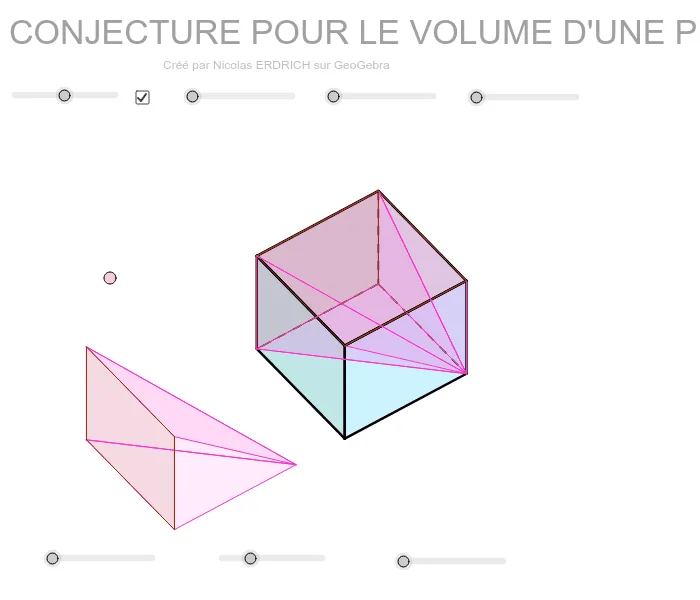
① This dynamic geometry example demonstrates the relationship between the volume of a pyramid, its base area, and height, guiding users to conjecture the formula V = (1/3)Sh. ② Core mathematical concepts include solid geometry (pyramid volume), proportional reasoning, and limit ideas, with scatter plots used to visualize data patterns. ③ Construction highlights: GeoGebra commands such as Sequence, Element, Point, Polygon, Segment, PointIn, and Translate are used to build the pyramid and its cross-sections; sliders adjust parameters; objects include z, w, v, a, O, P, β, sinβ, cosβ, α, sinα, cosα, X, Y, Z, echelle, R_x, R_y, cube, texte1, texte2, Mat, cube', AE, droite, listepoints, A, E, C_1, D, poly1, a_1, b, c_1, d, B, F, G, H, poly2, with translations and point sequences generating volume measurement data. ④ Suitable for upper secondary students (e.g., geometry enrichment or introductory solid geometry) to explore the pyramid volume formula, and for math lab activities or teacher demonstrations, helping learners move from hands-on manipulation to formal derivation.
GeoGebra Commands & Parameters
Sequence(Mat * Element[cube, k], k, 1, 8) → cube'Element(Element[AE, 3], 1) → droiteSequence((Element[cube', k, 1, 1], Element[cube', k, 2, 1]), k, 1, 8) → listepointsPoint(listepoints) → APoint(listepoints) → EPoint(listepoints) → C_1Point(listepoints) → DPolygon(A, E, C_1, D) → poly1, a_1, b, c_1, dPoint(listepoints) → BPoint(listepoints) → FPoint(listepoints) → GPoint(listepoints) → HPolygon(B, F, G, H) → poly2, e, f, g, hPoint(listepoints) → CPolygon(F, C, A, B) → poly3, f_1, i, a_2, b_1Element(AB, 3, 1) → avantPolygon(C_1, G, H, E) → poly4, c_2, g_1, h_1, e_1Element(AC, 3, 1) → dessusPolygon(F, C, C_1, G) → poly5, f_2, c_3, c_4, g_2Polygon(A, B, H, E) → poly6, a_3, b_2, h_2, e_2Segment(E, A) → cSegment(A, C) → jSegment(A, B) → kSegment(C, C_1) → lSegment(C_1, E) → mSegment(H, E) → nSegment(A, B) → pSegment(B, H) → qSegment(H, E) → rSegment(H, G) → sSegment(B, F) → tSegment(G, C_1) → d_1Segment(F, G) → i_1Segment(F, C) → j_1PointIn(poly5) → JTranslate(J, Vector[val1 * Vector[A, B]]) → pyr1_1Translate(A, Vector[val1 * Vector[A, B]]) → pyr1_2Translate(B, Vector[val1 * Vector[A, B]]) → pyr1_3Translate(H, Vector[val1 * Vector[A, B]]) → pyr1_4Translate(E, Vector[val1 * Vector[A, B]]) → pyr1_5Polygon(pyr1_1, pyr1_2, pyr1_3) → poly11, pyr1_6, pyr1_7, pyr1_8Polygon(pyr1_1, pyr1_3, pyr1_4) → poly12, pyr1_9, pyr1_{10}, pyr1_{11}Polygon(pyr1_5, pyr1_1, pyr1_2) → poly13, pyr1_{12}, pyr1_{13}, pyr1_{14}Polygon(pyr1_5, pyr1_4, pyr1_3, pyr1_2) → poly14, pyr1_{15}, pyr1_{16}, pyr1_{17}, pyr1_{18}Translate(J, Vector[val2 * Vector[A, E]]) → pyr2_1Translate(E, Vector[val2 * Vector[A, E]]) → pyr2_2Translate(H, Vector[val2 * Vector[A, E]]) → pyr2_3Translate(C_1, Vector[val2 * Vector[A, E]]) → pyr2_4Translate(G, Vector[val2 * Vector[A, E]]) → pyr2_5Polygon(pyr2_1, pyr2_2, pyr2_3) → poly15, pyr2_6, pyr2_7, pyr2_8Polygon(pyr2_1, pyr2_4, pyr2_5) → poly16, pyr2_9, pyr2_{10}, pyr2_{11}Polygon(pyr2_1, pyr2_3, pyr2_5) → poly17, pyr2_{12}, pyr2_{13}, pyr2_{14}Polygon(pyr2_4, pyr2_2, pyr2_3, pyr2_5) → poly18, pyr2_{15}, pyr2_{16}, pyr2_{17}, pyr2_{18}Translate(J, Vector[val3 * Vector[D, A]]) → pyr3_1Translate(F, Vector[val3 * Vector[D, A]]) → pyr3_2Translate(B, Vector[val3 * Vector[D, A]]) → pyr3_3Translate(G, Vector[val3 * Vector[D, A]]) → pyr3_4Translate(H, Vector[val3 * Vector[D, A]]) → pyr3_5Polygon(pyr3_1, pyr3_3, pyr3_2) → poly19, pyr3_6, pyr3_7, pyr3_8Polygon(pyr3_2, pyr3_4, pyr3_5, pyr3_3) → poly20, pyr3_9, pyr3_{10}, pyr3_{11}, pyr3_{12}Polygon(pyr3_1, pyr3_2, pyr3_4) → poly21, pyr3_{13}, pyr3_{14}, pyr3_{15}Polygon(pyr3_1, pyr3_5, pyr3_4) → poly22, pyr3_{16}, pyr3_{17}, pyr3_{18}
AI Drawing Prompt Reference
Draw a pyramid to demonstrate the relationship between its volume, base area, and height, using scatter plots to visualize data patterns. The pyramid consists of multiple polygons forming its base and sides, with sliders adjusting parameters. Show cross-sections of the pyramid and use dynamic graphics to display volume measurement data, guiding users to conjecture the volume formula V = (1/3)Sh.
The prompt above was compiled from the original drawing commands and is for reference only.