
Net for a Rectangular Prism by David Boudreaux
Loading the math board and drawing, please wait…
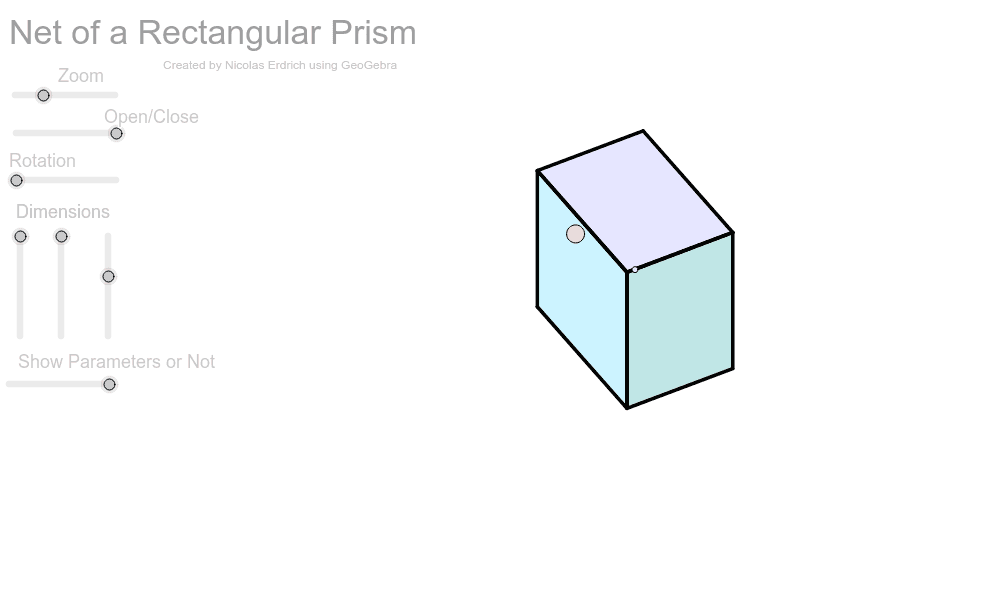
This GeoGebra example demonstrates the net of a rectangular prism, which is the unfolding of a three-dimensional rectangular prism into a two-dimensional plane. The core mathematical concepts involved include solid geometry, polygon construction, coordinate transformations, and trigonometry. In terms of construction, it uses GeoGebra commands such as Sequence to generate point sequences, Element to access elements, Polygon to draw faces, and Segment to draw edges. Key objects include rotation matrices R_z, R_y, R_x, angles α and β, trigonometric functions sin and cos, and the cube object. This is suitable for teaching solid geometry in high school or early college, aiding in understanding the development of 3D shapes.
GeoGebra Commands & Parameters
Sequence((Mat * Element[cube, k]), k, 1, 8) → cube'Element(Element[AE, 3], 1) → droiteSequence(I + (Element[cube', k, 1, 1], Element[cube', k, 2, 1]), k, 1, 8) → listepointsElement(listepoints, 2) → AElement(listepoints, 1) → EElement(listepoints, 4) → C_1Element(listepoints, 3) → DPolygon(A, E, C_1, D) → poly1, a_1, b, c_1, dElement(listepoints, 6) → BElement(listepoints, 7) → FElement(listepoints, 8) → GElement(listepoints, 5) → HPolygon(B, F, G, H) → poly2, e, f, g, hElement(listepoints, 3) → CPolygon(F, C, A, B) → poly3, f_1, i, a_2, b_1Element(AB, 3, 1) → avantPolygon(C_1, G, H, E) → poly4, c_2, g_1, h_1, e_1Element(AC, 3, 1) → dessusPolygon(F, C, C_1, G) → poly5, f_2, c_3, c_4, g_2Polygon(A, B, H, E) → poly6, a_3, b_2, h_2, e_2Segment(E, A) → cSegment(A, C) → jSegment(A, B) → kSegment(C, C_1) → lSegment(C_1, E) → mSegment(A, B) → pSegment(B, H) → qSegment(H, E) → rSegment(H, G) → sSegment(B, F) → tSegment(G, C_1) → d_1Segment(F, G) → i_1Segment(F, C) → j_1Polygon(A, B, F', D') → poly7, a_4, b_3, f', d'Polygon(E, A, D'', C') → poly8, e_3, a_5, d'', c'Polygon(B, F'', G', H) → poly9, b_4, f'', g', h_3Polygon(H, G'', C''', E) → poly10, h_4, g'', c''', e_4Polygon(A_2, B_2, G'', C''') → poly11, a_6, b_5, g''_1, c'''_1
AI Drawing Prompt Reference
Draw a planar net of a rectangular prism. First obtain eight flat vertices through coordinate transformation, then connect them to form six rectangular faces representing the sides, top, and bottom of the prism. Continue by unfolding or hinging additional rectangular faces along relevant edges so that all faces lie in one plane, producing a foldable cuboid net. Keep the vertices, rectangle edges, and unfolded boundaries visible, clearly showing how a three-dimensional rectangular prism is developed into a two-dimensional layout.
The prompt above was compiled from the original drawing commands and is for reference only.