
Square Pyramid by David Boudreaux
Loading the math board and drawing, please wait…
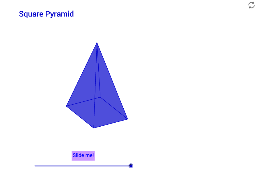
This example demonstrates the geometric construction and properties of a square pyramid. It involves core mathematical concepts such as solid geometry, polygons, angles, and vectors. The construction uses GeoGebra commands like Circle, Point, Intersect, Polygon, Midpoint, Line, Angle, Rotate, and Segment. It is suitable for high school students and mathematics enthusiasts studying solid geometry and geometric constructions.
GeoGebra Commands & Parameters
Circle(A, a) → cPoint(c) → BCircle(B, a) → dIntersect(c, d) → C, D, ,Point(d) → ECircle(E, a) → eIntersect(e, c) → F, G, ,Polygon(A, B, E, G) → poly1, a_1, b, e_1, gMidpoint(g) → HMidpoint(e_1) → IMidpoint(b) → JMidpoint(a_1) → KLine(K, I) → fLine(H, J) → h_1Intersect(h_1, f) → LCircle(L, a + h) → kIntersect(k, h_1) → M, NIntersect(k, f) → O, PPolygon(B, N, E) → poly2, e_2, b_1, n_1Polygon(G, P, E) → poly3, e_3, g_1, pPolygon(A, M, G) → poly4, g_2, a_2, mPolygon(A, O, B) → poly5, b_2, a_3, oLine(L, yAxis) → iPoint(i) → QAngle(Q, L, M) → αAngle(Q, L, O) → βAngle(P, L, Q) → γAngle(N, L, Q) → δRotate(M, (-((n * α))), L) → M'Rotate(O, (-((n * β))), L) → O'Polygon(A, M', G) → poly6, g_3, a_4, m'Polygon(O', A, B) → poly7, b_3, o', a_5Angle(N, B, Q) → εRotate(P, (n * γ), L) → P'Polygon(G, P', E) → poly8, e_4, g_4, p'Rotate(N, (n * δ), L) → N'Polygon(E, N', B) → poly9, b_4, e_5, n'Polygon(B, E, N') → poly10, n'_1, b_5, e_6Polygon(R, S, 4) → poly11, j, l, q, r, T, UCircle(U, V) → sCircle(T, Distance[U, V]) → tIntersect(s, t, 1) → WSegment(U, W) → c_1Segment(W, T) → d_1Polygon(U, T, W) → poly12, w, u, t_1Segment(R, T) → f_1Midpoint(f_1) → ZRotate(U, 90°, Z) → U'Rotate(T, 90°, Z) → T'Rotate(W, 90°, Z) → W'Polygon(U', T', W') → poly12', w', u', t'Rotate(U, 180°, Z) → U'_1Rotate(T, 180°, Z) → T'_1Rotate(W, 180°, Z) → W'_1Polygon(U'_1, T'_1, W'_1) → poly12'_1, w'_1, u'_1, t'_1Rotate(U, 270°, Z) → U'_2Rotate(T, 270°, Z) → T'_2Rotate(W, 270°, Z) → W'_2Polygon(U'_2, T'_2, W'_2) → poly12'_2, w'_2, u'_2, t'_2