
Negative Rational Exponents: Graphical Meaning and Practice
Loading the math board and drawing, please wait…
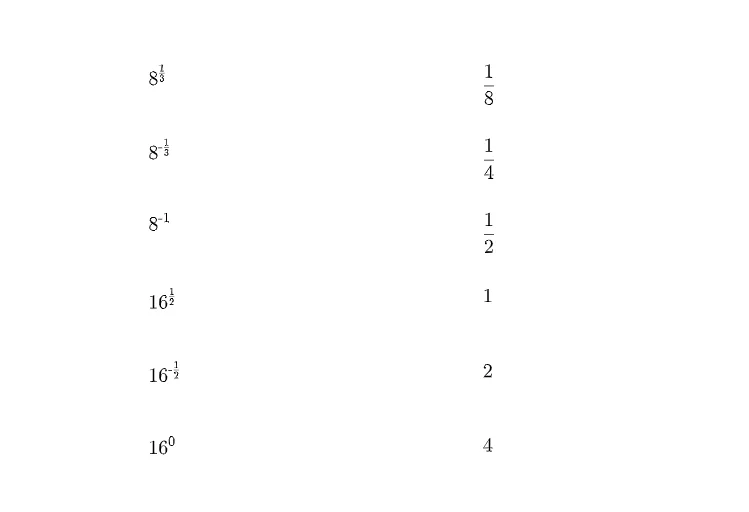
This GeoGebra example demonstrates how negative rational exponents translate into the behavior of power functions—combining roots with reciprocals—and how the graph changes accordingly. The key concepts include the definition of rational exponents a^(m/n) as an n-th root, and negative exponents as reciprocals (a^(-k)=1/a^k), as well as the resulting domain restrictions and graph features such as possible undefined points. Construction-wise, the model is organized with multiple text elements (text1–text12) to present the steps, formulas, and visual interpretation in a structured way, supporting a concept-to-graph learning flow. This is suitable for upper secondary and early university preparatory learners studying exponent laws and power-function graph comprehension.
AI Drawing Prompt Reference
Plot and annotate power-function graphs on a coordinate plane to illustrate how negative rational exponents combine “roots” with reciprocals. Choose a base a (with a>0) and integers k and n, and state that a^(m/n) means the n-th root, while a^(-k)=1/a^k represents a reciprocal. Construct the corresponding power function curve(s) on the same axes, and highlight the resulting domain restrictions caused by the negative exponents, indicating any potentially undefined points where appropriate. Include short textual explanations that connect the algebraic meaning to the observed changes in the graph.
The prompt above was compiled from the original drawing commands and is for reference only.