
Multiplying Negative Numbers: Real-World Context with Walking
Loading the math board and drawing, please wait…
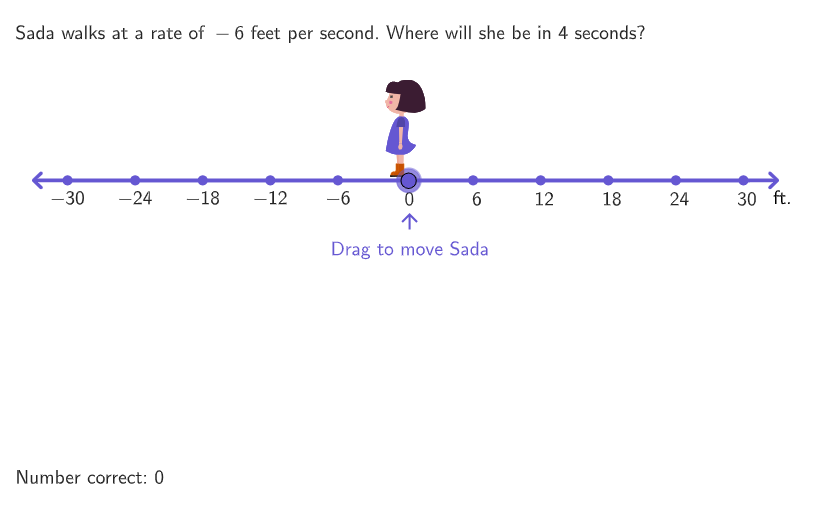
This example demonstrates the concept of multiplying negative numbers through a walking scenario, helping students understand the practical significance of negative multiplication. Key mathematical concepts include negative multiplication rules, number line representation, and sign operations. Construction involves GeoGebra commands such as Shuffle, Element, If, Textfield, etc., to create dynamic graphics. Suitable for middle school students (grades 6-8) for number sense development and mathematical thinking training.
GeoGebra Commands & Parameters
Shuffle(Sequence[-10, 10] \ {0, 1, -1}) → randomList1, {-6, -3, 7, 8, 2, -5, 6, -2, -7, -4, 5, 10, 4, -10, -8, 3, 9, -9}Element(randomList1, Mod[countQuestion, Length[randomList1]] + 1) → randomNum1Shuffle(Sequence[-5, 5] \ {-1, 0, 1, randomNum1, (-randomNum1)}) → randomList2, {4, 3, -4, -5, 5, 2, -2, -3}Element(randomList2, Mod[countQuestion, Length[randomList2]] + 1) → randomNum2If(randomNum1 ≥ 0, If[randomNum2 ≥ 0, 1, 3], If[randomNum2 ≥ 0, 2, 4]) → correctTextIf(randomNum1 ≤ 0, ((-wid), 0.05), (wid, 0.05)) → ATextfield(input1) → InputBox1Textfield(input2) → InputBox2Corner(5) → AppSizeSequence(16 + (ii * (167 + 8)), ii, 0, 3) → xoptions, {16, 191, 366, 541}Sequence((ii, 0), ii, -5, 5) → PointsSequence((-maxX) + (maxX / 5 * ii), ii, 0, 10) → scale, {-30, -24, -18, -12, -6, 0, 6, 12, 18, 24, 30}Translate(A, (0, hei)) → A'If(randomNum1 ≤ 0, E, F) → C1If(randomNum1 ≤ 0, F, E) → C2Translate(C1, Vector[A, A']) → C3If(slideToAnimate ≟ 0, 1, Mod[abs(slideToAnimate), 4] + 2) → numImgTranslate(If[randomNum1 ≤ 0, A, B], ((E - If[randomNum1 ≤ 0, A, B]) * timer)) → CIf(randomNum1 ≤ 0, C, D) → D1If(randomNum1 ≤ 0, D, C) → D2If(timer ≟ 1 ∨ timer ≟ 0, 1, Mod[(timer * 10), 4] + 2) → numImg2Zip(Text[(If[AA ≥ 0, "\hspace{7}", ""] * AA), BB - (0, 0.02), true, true, 0, -1], AA, scale, BB, Points) → l1Segment((-5.5, 0), (5.5, 0)) → numberLineText("\textsf{ft.}", (5.85, -0.2), true, true, -1, 0) → text2Translate(D1, Vector[A, A']) → D3Sort(Sequence[(((ii * lengtVec) * sgn((randomNum1 * randomNum2))), -0.5), ii, 0, abs(randomNum2)]) → vectorEndpointsZip(Vector[If[randomNum1 ≤ 0, QQ, PP], If[randomNum1 ≤ 0, PP, QQ]], PP, vectorEndpoints, QQ, Take[vectorEndpoints, 2]) → vectorsListText((((("$" * abs(randomNum2)) * "\text{ seconds, }") * positiveProd) * "\text{ feet}$"), Midpoint[vectorEndpoints(1), vectorEndpoints(-1)], true, true, 0, -1) → text4Text((If[slideToAnimate ≥ 0, "\hspace{7}", ""] * slideToAnimate), Midpoint[C1, C2] + (0, (10 / 9 * y(C3))), true, true, 0, 0) → text1Translate(hGuideLine, Vector[(Vector[Corner[4], Corner[1]] / 500 * 16)]) → hGuideLine'onboardingTextOffset(Corner[onboardingText_{1}, 1], Corner[onboardingText_{1}, 3], onboardingCase_{1}, Corner[1], Corner[3], Corner[5]) → OnboardingTextOffset_{1}circlePixels((0.05, 0), 9 + (7 * pulsing), Corner[1], Corner[3], Corner[5]) → pulsingObject
AI Drawing Prompt Reference
Draw a number line showing positive and negative numbers to illustrate multiplying two negative numbers in a walking scenario. Randomly select two negative numbers, represent walking direction and distance with arrows, and calculate the result based on multiplication rules. Label the product and dynamically show the walking process including start point, end point, and product to help understand the practical significance of negative multiplication.
The prompt above was compiled from the original drawing commands and is for reference only.