
Multiplying Complex Numbers on the Complex Plane
Loading the math board and drawing, please wait…
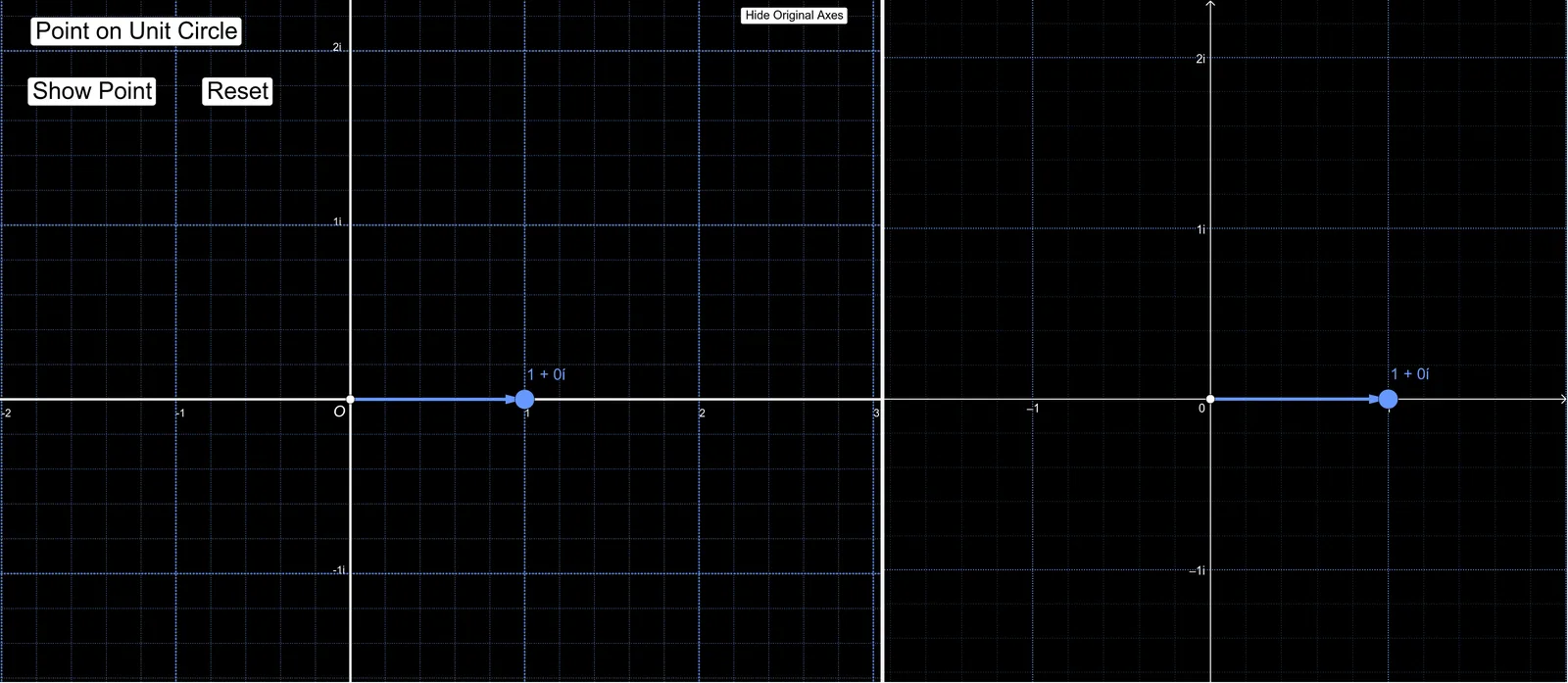
This GeoGebra example visualizes the multiplication of two complex numbers on the complex plane, demonstrating geometrically that the product's modulus is the product of the moduli and its argument is the sum of the arguments. It uses vectors to represent complex numbers, a unit circle to show rotation, and dynamic points to illustrate the effect of scaling and rotating. Key concepts include polar form of complex numbers, vector operations, and trigonometric functions. The construction employs commands such as Vector, Circle, Point, Rotate, Sequence, Join, Text, and If to build the interactive diagram with coordinate grids, labels, and conditional displays. Suitable for high school or introductory college students learning complex numbers, and useful for teachers to explain the geometric interpretation of complex multiplication.
GeoGebra Commands & Parameters
Vector(O, P'') → jCircle(O, A) → UnitCirclePoint(UnitCircle) → BIf(unit, abs(B), abs(C)) → rIf(r > 1, xMin, floor(xMin / r)) → xMinStretchSequence(Line[(-1, i), (1, i)], i, yMin, yMax, 1 / 5) → yMinorLinesSequence(Line[(-1, i), (1, i)], i, yMin, yMax, 1) → yMajorLinesSequence(Line[(i, -1), (i, 1)], i, xMin, xMax, 1) → xMajorLinesSequence(Line[(i, -1), (i, 1)], i, xMin, xMax, 1 / 5) → xMinorLinesJoin({{Sequence[Text[i, (i, -0.1)], i, xMin, -1]}, {Sequence[Text[i, (i, -0.1)], i, 1, xMax]}}) → xNumbersIf(unit, Angle[B], Angle[C]) → angText("O", (-0.1, -0.1)) → OriginNumberRotate(xaxis, ang) → xaxis'Rotate(xaxis', π / 2) → yaxis'If(r > 1, xMax, ceil(xMax / r)) → xMaxStretchSequence(Line[((r * i), -1), ((r * i), 1)], i, xMinStretch, xMaxStretch, 1) → xMajorStretchRotate(xMajorStretch, ang) → xMajorLines'Sequence(Line[((r * i), -1), ((r * i), 1)], i, xMinStretch, xMaxStretch, 1 / 5) → xMinorStretchRotate(xMinorStretch, ang) → xMinorLines'Sequence(Line[(-1, (r * i)), (1, (r * i))], i, xMinStretch, xMaxStretch, 1) → yMajorStretchRotate(yMajorStretch, ang) → yMajorLines'Sequence(Line[(-1, (r * i)), (1, (r * i))], i, xMinStretch, xMaxStretch, 1 / 5) → yMinorStretchRotate(yMinorStretch, ang) → yMinorLines'Join({{Sequence[Text[i, (((r * i) * cos(ang)), ((r * i) * sin(ang)) - 0.1)], i, xMin, -1]}, {Sequence[Text[i, (((r * i) * cos(ang)), ((r * i) * sin(ang)) - 0.1)], i, 1, xMax]}}) → xNumbers'Join({{Sequence[Text[(i * "i"), (((r * i) * cos(ang + π / 2)) - 0.1, ((r * i) * sin(ang + π / 2)))], i, xMin, -1]}, {Sequence[Text[(i * "i"), (((r * i) * cos(ang + π / 2)) - 0.1, ((r * i) * sin(ang + π / 2)))], i, 1, xMax]}}) → yNumbers'Join({{Sequence[Text[(i * "i"), (-0.15, i)], i, yMin, -1]}, {Sequence[Text[(i * "i"), (-0.1, i)], i, 1, yMax]}}) → yNumbersVector(O, C) → uVector(O, B) → vVector(O, P) → wVector(O, P') → hCircle(O, P') → secondcircleVector(O, R') → aVector(O, R'') → b
AI Drawing Prompt Reference
Visualize the multiplication of two complex numbers on the complex plane using vectors to represent the numbers, a unit circle to show rotation, and dynamic points to illustrate scaling and rotation. Demonstrate that the modulus of the product is the product of the moduli and the argument is the sum of the arguments. Include coordinate grids, labels, and conditional displays suitable for high school or introductory college students learning complex numbers, and useful for teachers to explain the geometric interpretation of complex multiplication.
The prompt above was compiled from the original drawing commands and is for reference only.