
Multiplication and Division of Complex Numbers
Loading the math board and drawing, please wait…
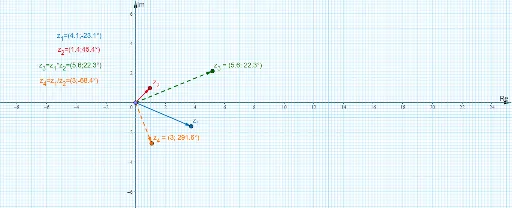
This example demonstrates the multiplication and division of complex numbers. Key mathematical concepts include the multiplication and division of complex numbers. Using GeoGebra commands such as Point, Sequence, Length, RotateText, etc., the geometric meaning of complex number multiplication and division is visually illustrated. Suitable for high school mathematics education and learning.
GeoGebra Commands & Parameters
Point(Curve) → ASequence(Segment[(i, -10), (i, 100)], i, -50, 50, 0.1) → list3Length(Corner[3] - Corner[1]) → tRotateText("y", 0) → text3Sequence(Segment[(-10, i), (100, i)], i, -50, 50, 0.1) → list1Sequence(Segment[(-10, i), (100, i)], i, -50, 50, 1) → list2Sequence(Segment[(i, -10), (i, 100)], i, -50, 50, 1) → list4Point(list4) → BVector(B, z_1) → uVector(B, z_2) → vVector(B, z_4) → wVector(B, z_3) → a
AI Drawing Prompt Reference
Draw the geometric meaning of complex number multiplication and division. First, draw the x-axis and y-axis, then draw a series of parallel lines to these axes. Mark points A and B on these lines, and then draw vectors u, v, w, and a from point B to complex numbers z1, z2, z3, and z4, respectively, to illustrate the geometric interpretation of complex number multiplication and division.
The prompt above was compiled from the original drawing commands and is for reference only.