
More Properties of the Jerabek Hyperbola
Loading the math board and drawing, please wait…
In collections
A Tour of Triangle Geometry
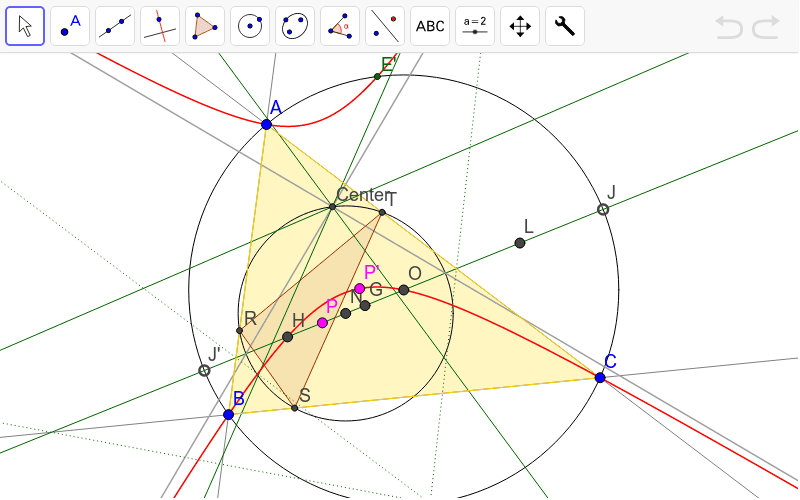
This example demonstrates the properties of the Jerabek hyperbola, which is the isogonal conjugate of the Euler line. By constructing the hyperbola, we can observe its intersection with the circumcircle at point E'. Using GeoGebra commands such as Line, Circle, Intersect, etc., we can explore the geometric properties of the hyperbola. Suitable for high school geometry education.
GeoGebra Commands & Parameters
Line(A, B) → aLine(B, C) → bLine(C, A) → cCircle(A, B, C) → dCenter(d) → OOrthogonalLine(C, a) → eOrthogonalLine(A, b) → fIntersect(e, f) → HLine(H, O) → gMirror(H, O) → LMidpoint(B, A) → DSegment(C, D) → hIntersect(g, h) → GMidpoint(B, C) → E_1Midpoint(C, A) → FCircle(D, F, E_1) → kCenter(k) → NPoint(g) → PMirror(P, c) → P'_3Mirror(P, b) → P'_1Mirror(P, a) → P'_2Circle(P'_3, P'_2, P'_1) → pCenter(p) → P'Locus(P', P) → loc1Polygon(A, B, C) → poly1, c_1, a_1, b_1Intersect(d, g) → J', JOrthogonalLine(J, c) → iOrthogonalLine(J, b) → jIntersect(i, c) → KIntersect(b, j) → MLine(K, M) → lOrthogonalLine(J', a) → mOrthogonalLine(J', b) → nIntersect(b, n) → IIntersect(a, m) → QLine(I, Q) → qMirror(g, a) → g'Mirror(g, c) → g'_1Mirror(g, b) → g'_2Intersect(g', g'_1) → EMirror(E, O) → E'OrthogonalLine(B, c) → rIntersect(a, e) → RIntersect(k, f, 1) → SIntersect(c, r) → TPolygon(R, S, T) → poly2, t, r_1, sIntersect(l, q) → CenterTool1(A, R, T) → d_1Tool1(C, T, S) → e_1Tool1(S, R, B) → f_1
AI Drawing Prompt Reference
Draw a triangle and its circumcircle. Find the intersection of the perpendicular bisector of one side with the circumcircle. Use this point to draw a circle that intersects the other two sides. Connect these intersection points to the vertices of the triangle and draw perpendicular lines. Observe the intersections of these perpendiculars with the triangle's sides and connect them to form a new shape. Finally, draw a line from the midpoint of one side to the opposite vertex and its perpendicular line, noting the intersections with the previous shapes.
The prompt above was compiled from the original drawing commands and is for reference only.