
Modular Times Table on a Square
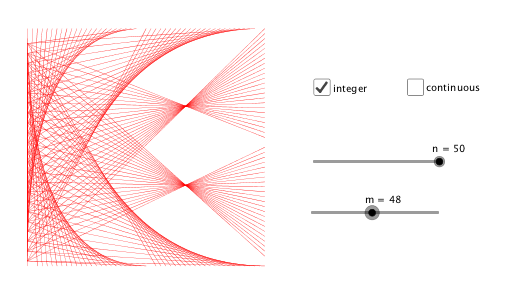
Loading the math board and drawing, please wait…
① This example visualizes the modular multiplication table on a square boundary, drawing line segments between points corresponding to multiplication results modulo n, creating dynamic geometric patterns. ② Core mathematical concepts include modular arithmetic (remainders), multiplication tables, congruence relations in number theory, and the use of geometric transformations (rotation, sequence) for visualization. ③ Construction details: Using GeoGebra commands Point, Polygon, Sequence, Rotate, and Join, it defines a square poly1, parameters n and m, generates point lists list1 through list6 via sequences, and connects points with lines; sliders control n and m for dynamic exploration. ④ Suitable for high school to early university students, this example bridges number theory and geometry, and serves as a hands-on tool for mathematical experiments or computational visualization lessons.
GeoGebra Commands & Parameters
Point(xAxis) → APoint(xAxis) → BPolygon(A, B, 4) → poly1, f, g, h, i, C, DSequence(A + (t * (D - A) / m), t, 0, m - 1) → list1Rotate(list1, π / 2, Centroid[poly1]) → list2Rotate(list1, π, Centroid[poly1]) → list3Rotate(list1, ((-π)) / 2, Centroid[poly1]) → list4Join({list1, list2, list3, list4}) → list5Sequence(Segment[Element[list5, i], Element[list5, Mod[(i * n), m]]], i, 1, (4 * m)) → list6