
Modular Multiplication on a Disc
Loading the math board and drawing, please wait…
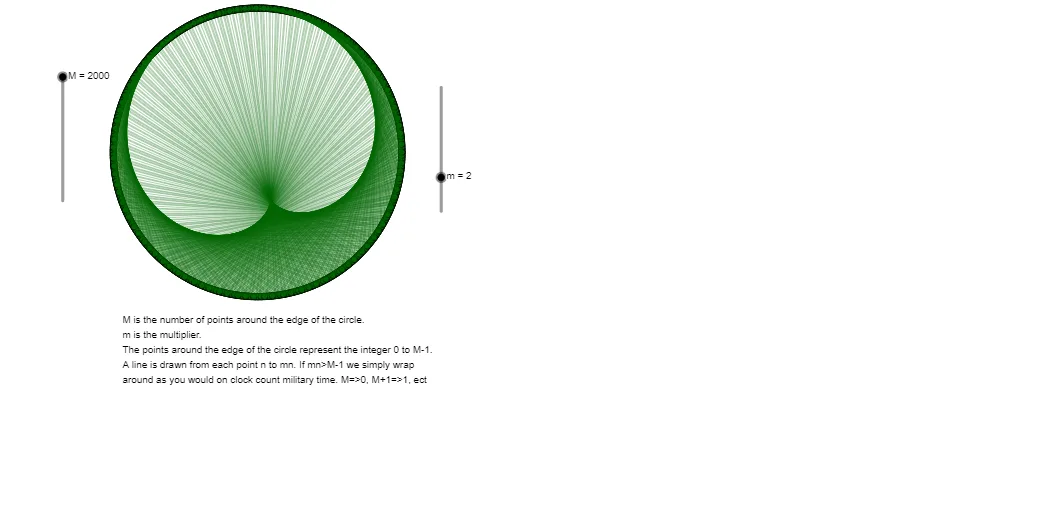
① This example visualizes modular multiplication on a disc, mapping multiplication results to points on a circle to reveal the periodic and symmetric nature of modular arithmetic. ② Core mathematical concepts include modular arithmetic, multiplication groups, congruence relations, and the geometric representation of discrete number theory on a continuous circle. ③ Construction highlights: using GeoGebra's Sequence command to generate points, with objects M, h₂, l1, m, l2, a, and text1; a slider or parameter controls the multiplier, dynamically updating point positions on the circle and displaying the corresponding modular result as text. ④ Suitable for upper secondary to early university students, ideal for introductory number theory, intuitive abstract algebra, or math lab activities, helping learners connect discrete operations with geometric visualization.
GeoGebra Commands & Parameters
Sequence((5; (((h_{2} * 2) * pi) * n)), n, 0, M, 1) → l1Sequence(Segment[Element[l1, n], Element[l1, (m * n)]], n, 1, M, 1) → l2
AI Drawing Prompt Reference
Draw a disc (or circle) on a plane and visualize modular multiplication by placing discrete points on the circumference. Introduce a slider-like multiplier parameter m, and define an angle rule so that for integers n the mapped positions move along the circle with periodic behavior. Generate a sequence of points on the circle using the parametrized angle (based on the step π and the factor involving m), then connect points in the sequence with short segment links between consecutive indices to form a chain of chord-like segments. Include a text area to display the modular multiplication/congruence result associated with the current parameter m, emphasizing the periodic and symmetric geometric pattern.
The prompt above was compiled from the original drawing commands and is for reference only.