
Midpoints of Any Quadrilateral Form a Parallelogram by Matthew Eastmond (2)
Loading the math board and drawing, please wait…
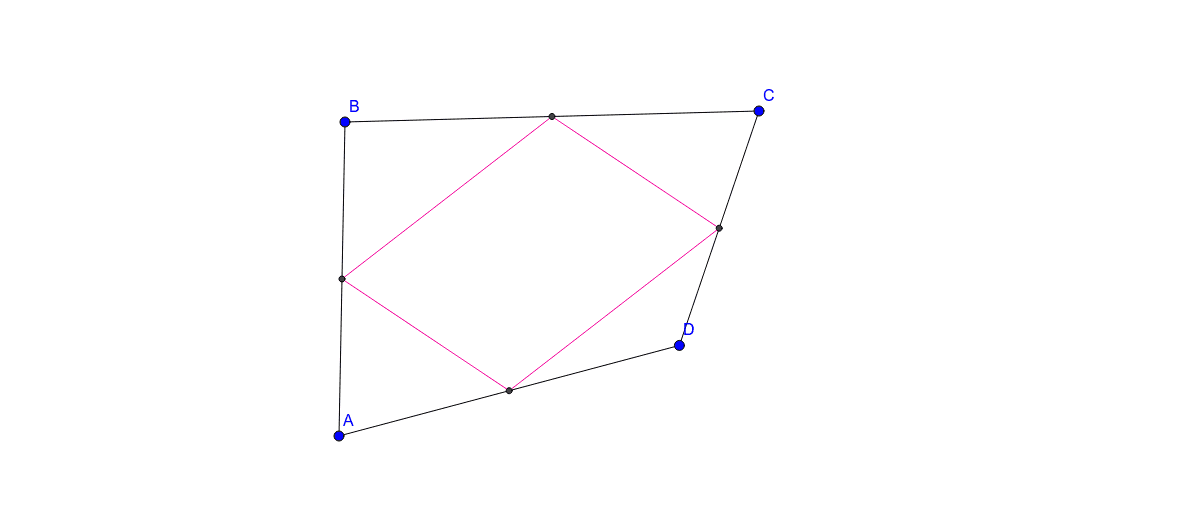
This example demonstrates that the midpoints of any quadrilateral form a parallelogram. Key mathematical concepts include midpoints and properties of parallelograms. By constructing the midpoints E, F, G, H of quadrilateral ABCD and connecting them, it can be proven that EFGH is a parallelogram. The commands used include Segment and Midpoint. Suitable for students at the junior high school level and above for geometric construction.
GeoGebra Commands & Parameters
Segment(A, B) → fSegment(B, C) → gSegment(C, D) → hSegment(D, A) → iMidpoint(A, D) → EMidpoint(A, B) → FMidpoint(B, C) → GMidpoint(C, D) → HSegment(F, E) → jSegment(F, G) → kSegment(G, H) → lSegment(H, E) → m
AI Drawing Prompt Reference
Draw an arbitrary quadrilateral with four vertices connected by four sides. Locate the midpoint of each side, giving four midpoints. Connect these midpoints in order to form a new quadrilateral. This new quadrilateral is a parallelogram, meaning its opposite sides are parallel and equal in length. The figure should show the original quadrilateral, the four midpoints, and the parallelogram formed by connecting them, with the midpoints clearly marked.
The prompt above was compiled from the original drawing commands and is for reference only.