
MHF4UC Transformations of Exponential Functions
Loading the math board and drawing, please wait…
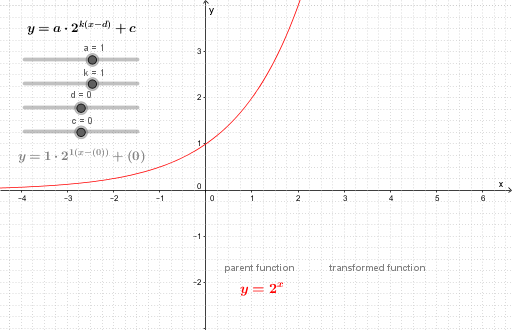
① This GeoGebra example dynamically demonstrates transformations of exponential functions of the form y = a·f(k(x-d)) + c, showing how translations, stretches, and reflections affect the graph. ② Core mathematical concepts include exponential functions, function transformations (horizontal/vertical shifts, horizontal/vertical scaling, reflections across axes), and the geometric meaning of parameters k, a, d, and c. ③ Construction highlights: from the summary, sliders k, a, d, c control transformation parameters; functions f and g define the original and transformed functions; parent and trans represent the parent function and the transformed result; standard and subbed handle expression standardization and substitution; origlabel and translabel label the graphs. The construction creates an interactive environment for exploring transformations. ④ Suitable for high school (e.g., MHF4UC course) or pre-university students learning function transformations, and for teachers to demonstrate how parameter changes correspond to graph shifts, stretches, and compressions.
GeoGebra Commands & Parameters
Numeric k(1.0)Numeric a(1.0)Numeric d(0.0)Numeric c(0.0)f(x) = (a * 2^((k * (x - d)))) + cg(x) = 2^(x)
AI Drawing Prompt Reference
Draw a coordinate plane with a base exponential curve that rises smoothly from left to right. Then, using four adjustable parameters, apply transformations to this curve: horizontal and vertical shifts, horizontal and vertical scaling, and possible reflections across the axes. Show both the original and transformed curves in the same plot, using different colors or line styles to distinguish them, so that the effect of each parameter change is clearly visible. The layout should be clean and suitable for interactive exploration.
The prompt above was compiled from the original drawing commands and is for reference only.