
Medians, Centroid, Altitudes, and Orthocenter by 60000693
Loading the math board and drawing, please wait…
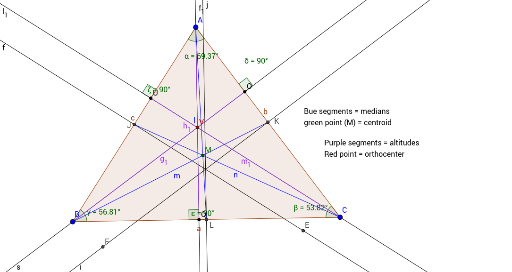
① This example dynamically demonstrates the classic properties of a triangle: the three medians intersect at the centroid, and the three altitudes intersect at the orthocenter, while also showing the relative positions of medians and altitudes. ② Core mathematical concepts include medians, centroid (intersection of medians), altitudes, orthocenter (intersection of altitudes), and how these special points relate to triangle types (acute, right, obtuse). ③ Construction highlights: using GeoGebra commands such as Polygon to create triangle poly1, Line and Segment to draw medians and altitudes, Intersect to find points like centroid G and orthocenter H, plus Circle and Angle for auxiliary markings. The object list includes A, B, C, poly1, c, a, b, α, β, γ, d, e, D, E, f, g, h, F, G, i, k, p, H, I, j, J, K, L, l, m, n, M, text1, q, r, N, s, O, t, c_1, showing a complete construction workflow. ④ Suitable for middle school geometry (triangle properties) and high school coordinate geometry, ideal for teacher demonstrations or student exploration of dynamic changes in special triangle points.
GeoGebra Commands & Parameters
Polygon(A, B, C) → poly1, c, a, bAngle(B, A, C) → αAngle(A, C, B) → βAngle(C, B, A) → γCircle(A, B) → dCircle(B, A) → eIntersect(d, e, 2) → DIntersect(d, e, 1) → ELine(D, E) → fCircle(A, C) → gCircle(C, A) → hIntersect(g, h, 2) → FIntersect(g, h, 1) → GLine(F, G) → iCircle(C, B) → kCircle(B, C) → pIntersect(k, p, 2) → HIntersect(k, p, 1) → ILine(H, I) → jIntersect(f, c) → JIntersect(i, b) → KIntersect(j, a) → LSegment(A, L) → lSegment(B, K) → mSegment(J, C) → nIntersect(l, m) → MCircle(A, B) → qCircle(C, B) → rIntersect(q, r, 2) → NLine(B, N) → sIntersect(s, b) → OCircle(B, A) → tCircle(C, A) → c_1Intersect(t, c_1, 2) → PLine(A, P) → f_1Intersect(f_1, a) → QSegment(B, O) → g_1Segment(A, Q) → h_1Circle(A, B) → d_1Circle(B, C) → e_1Intersect(d_1, e_1, 2) → RLine(R, C) → i_1Intersect(i_1, c) → SSegment(C, S) → j_1Angle(N, O, A) → δAngle(A, Q, B) → εCircle(A, C) → k_1Circle(B, C) → p_1Intersect(k_1, p_1, 2) → TLine(T, C) → l_1Intersect(l_1, c) → UAngle(A, U, T) → ζSegment(U, C) → m_1Intersect(s, f_1) → V