
Measure 2D Shape Area
Loading the math board and drawing, please wait…
In collections
P4 Area (I)
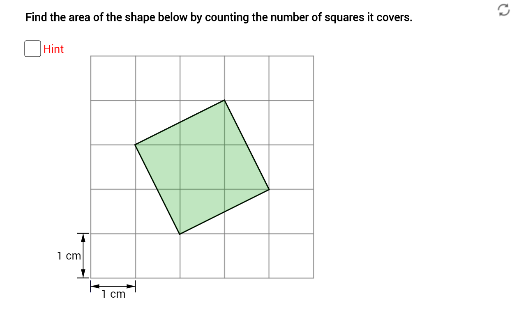
This example demonstrates how to measure the area of a 2D shape by counting the squares it covers. It involves core math concepts like area calculation and geometric intuition. GeoGebra commands and objects used include Segment, Vector, Point, Translate, and Polygon. Suitable for elementary and above, for geometric introduction and area concept teaching.
GeoGebra Commands & Parameters
Segment(X0, X0 + (0, 0.25)) → gSegment(X0, X0 + (0, mark)) → hSegment(X0 + (1, 0), X0 + (1, mark)) → iVector(X0 + (0, mark / 2), X0 + (1, mark / 2)) → uVector(X0 + (1, mark / 2), X0 + (0, mark / 2)) → vSegment(Y0 - (mark, 0), Y0) → jSegment(Y0 - (mark, 1), Y0 - (0, 1)) → kVector(Y0 - (mark / 2, 1), Y0 - (mark / 2, 0)) → wVector(Y0 - (mark / 2, 0), Y0 - (mark / 2, 1)) → zPoint(yAxis) → APoint(xAxis) → DTranslate(A, Vector[(t1 * Vector[A, D])]) → A'Translate(F, Vector[(t1 * Vector[A, D])]) → F'Translate(B, Vector[(t1 * Vector[A, D])]) → B'Polygon(A', F', B') → poly1, b', a', f'Translate(C, Vector[(t2 * Vector[D, A])]) → C'Translate(D, Vector[(t2 * Vector[D, A])]) → D'Translate(H, Vector[(t2 * Vector[D, A])]) → H'Translate(E, Vector[(t2 * Vector[D, A])]) → E'Polygon(C', D', H') → poly2, a, b, cTranslate(B, Vector[(t3 * Vector[B, A])]) → B'_1Translate(C, Vector[(t3 * Vector[B, A])]) → C'_1Translate(E, Vector[(t3 * Vector[B, A])]) → E'_1Polygon(B'_1, C'_1, E'_1) → poly3, e'_1, b'_1, c'_1Translate(A, Vector[(t4 * Vector[A, B])]) → A'_1Translate(G, Vector[(t4 * Vector[A, B])]) → G'Translate(D, Vector[(t4 * Vector[A, B])]) → D'_1Polygon(A'_1, G', D'_1) → poly4, d'_1, a'_1, g'Polygon(E, F, G, H) → poly5, e, f, g_1, h_1Polygon(A', F', B') → poly1', b'_2, a'_2, f'_1Polygon(C', D', H') → poly2', d, l, mPolygon(B'_1, C'_1, E'_1) → poly3', e'_2, b'_3, c'_2Polygon(A'_1, G', D'_1) → poly4', d'_2, a'_3, g'_1Polygon(A, B, C, D) → poly6, a_1, b_1, c_1, d_1Polygon(A, B, F) → poly7, f_1, a_2, b_2Polygon(B, C, E) → poly8, e_1, b_3, c_2Polygon(C, D, H) → poly9, h_2, c_3, d_2Polygon(A, G, D) → poly10, d_3, a_3, g_2