
Matrix Representation of a Dilation: Control Columns via Points
Loading the math board and drawing, please wait…
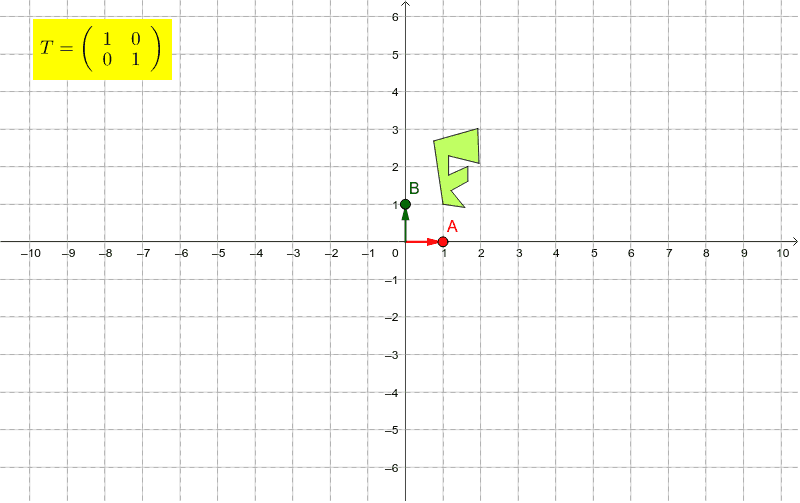
This GeoGebra example dynamically illustrates the matrix representation of a two-dimensional dilation (scaling) transformation. By dragging points A and B, users control the first and second columns of the transformation matrix T, respectively, allowing them to see how the column vectors determine the linear transformation's effect on a polygon. The core mathematical concepts include linear transformations, matrix multiplication, vectors, scaling, and images of geometric figures. The construction uses Point to create control points A and B, Vector to define column vectors, and ApplyMatrix to transform the vertices of polygon poly1 into poly1', while keeping the original for comparison. This resource is suitable for high school or early college students learning linear algebra or geometric transformations. By interactively adjusting matrix entries, learners can explore how different scaling factors and directions affect the shape, deepening their understanding of the connection between matrices and geometric transformations.
GeoGebra Commands & Parameters
Point(xAxis) → ASegment((0, 0), A) → aSequence((cos(t), sin(t)), t, 0*°, 350*°, 10*°) → ptsVector((0, 0), A) → uVector((0, 0), B) → vPolygon(C, D, E, F, G, H, I, J, K, L) → poly1, c, l, d, e, f, g, h, i, j, kApplyMatrix(matrix1, C) → C'ApplyMatrix(matrix1, D) → D'ApplyMatrix(matrix1, E) → E'ApplyMatrix(matrix1, F) → F'ApplyMatrix(matrix1, G) → G'ApplyMatrix(matrix1, H) → H'ApplyMatrix(matrix1, I) → I'ApplyMatrix(matrix1, J) → J'ApplyMatrix(matrix1, K) → K'ApplyMatrix(matrix1, L) → L'Polygon(C', D', E', F', G', H', I', J', K', L') → poly1', c', l', d', e', f', g', h', i', j', k'Sequence(Line[(t * B), u], t, -20, 20) → list1Sequence(Line[(t * A), v], t, -20, 20) → list2