
MATH 404 - Constructions
Loading the math board and drawing, please wait…
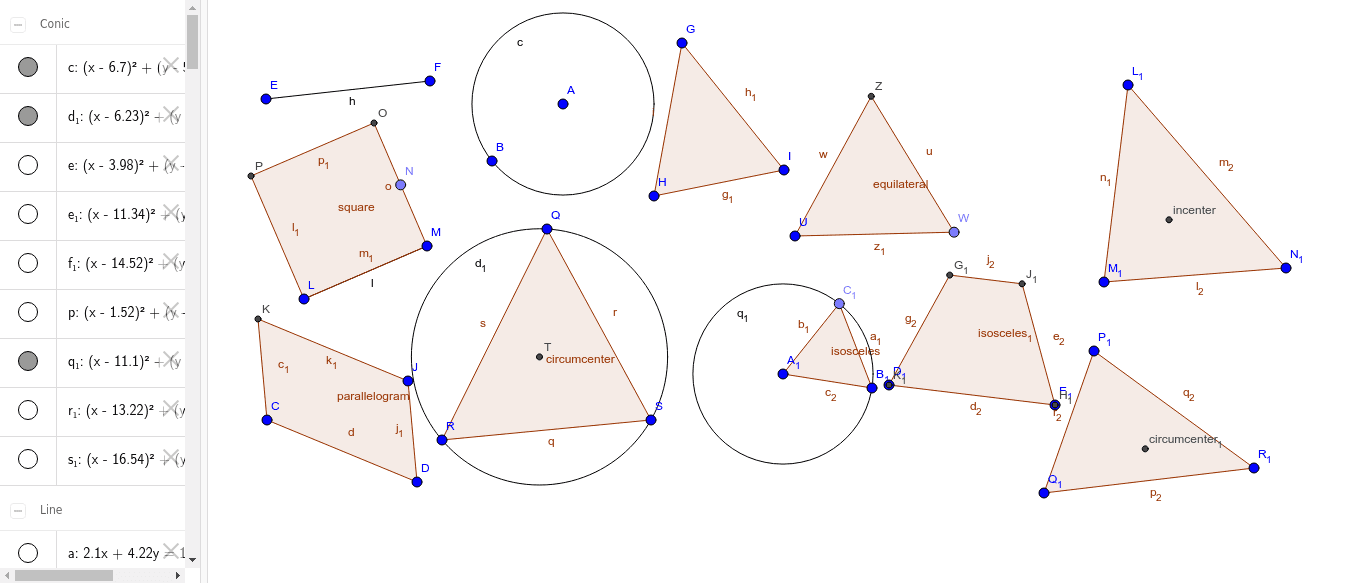
This GeoGebra example demonstrates a comprehensive set of geometric constructions, including circles, segments, polygons, lines, intersections, perpendiculars, midpoints, and angle bisectors. The core mathematical concepts involve classical geometric construction rules, parallel and perpendicular relationships, construction of polygons such as parallelograms and squares, and the visual representation of geometric transformations. The construction summary reveals the use of GeoGebra commands such as Circle, Segment, Polygon, Line, Intersect, OrthogonalLine, Point, LineBisector, and AngularBisector, with numerous objects labeled A through P, as well as named shapes like poly1, parallelogram, and square. This example is suitable for university-level mathematics courses (e.g., MATH 404) or advanced high school geometry, helping students understand the logical steps of geometric construction, relationships between figures, and precise construction techniques using dynamic geometry software.
GeoGebra Commands & Parameters
Circle(A, B) → cSegment(E, F) → hPolygon(G, H, I) → poly1, i, g_1, h_1Line(C, D) → fLine(J, f) → gLine(J, D) → jLine(C, j) → kIntersect(g, k) → KPolygon(K, J, D, C) → parallelogram, k_1, j_1, d, c_1Segment(L, M) → lOrthogonalLine(M, l) → mPoint(m) → NCircle(M, L) → eIntersect(e, m, 2) → OOrthogonalLine(L, l) → nCircle(L, M) → pIntersect(p, n, 2) → PPolygon(P, O, M, L) → square, p_1, o, m_1, l_1Polygon(Q, R, S) → circumcenter, s, q, rLineBisector(Q, S) → tLineBisector(Q, R) → aIntersect(t, a) → TCircle(T, Q) → d_1Circle(U, V) → e_1Point(e_1) → WCircle(W, U) → f_1Intersect(e_1, f_1, 1) → ZPolygon(Z, U, W) → equilateral, w, z_1, uCircle(A_1, B_1) → q_1Point(q_1) → C_1Polygon(A_1, B_1, C_1) → isosceles, c_2, a_1, b_1Line(D_1, E_1) → bLine(F_1, b) → i_1Circle(D_1, E_1) → r_1Circle(E_1, D_1) → s_1Intersect(s_1, i_1, 1) → G_1Intersect(r_1, b) → H_1, I_1Intersect(r_1, i_1, 2) → J_1Intersect(s_1, b, 1) → K_1Polygon(D_1, E_1, J_1, G_1) → isosceles_1, d_2, e_2, j_2, g_2Polygon(L_1, M_1, N_1) → poly8, n_1, l_2, m_2AngularBisector(L_1, M_1, N_1) → t_1AngularBisector(N_1, L_1, M_1) → f_2AngularBisector(M_1, N_1, L_1) → h_2Intersect(t_1, f_2) → incenterPolygon(P_1, Q_1, R_1) → poly9, r_2, p_2, q_2LineBisector(P_1, R_1) → i_2LineBisector(Q_1, R_1) → k_2LineBisector(Q_1, P_1) → n_2Intersect(i_2, k_2) → circumcenter_1