
Matching Quadratic Functions in Vertex Form by Thomas Gebbie
Loading the math board and drawing, please wait…
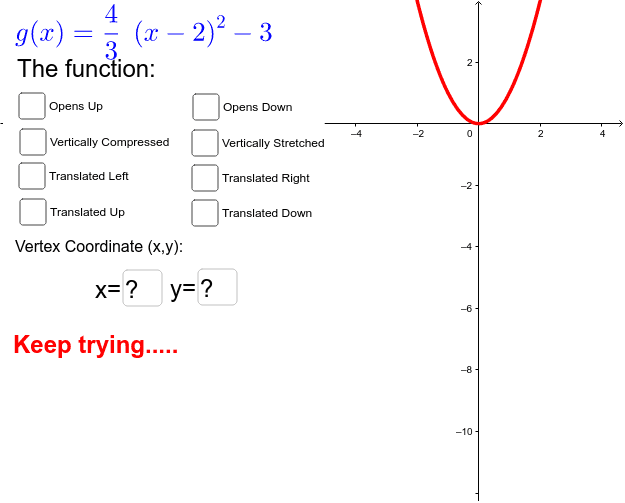
This interactive GeoGebra example is a matching exercise where students are asked to pair quadratic functions written in vertex form (y = a(x-h)^2 + k) with their corresponding graphical descriptions. The activity focuses on reinforcing the connection between the algebraic expression and the key features of the parabola, such as the vertex, axis of symmetry, direction of opening, and vertical/horizontal shifts. Core mathematical concepts include the vertex form of a quadratic function, transformations of graphs, the role of the coefficient 'a' in determining concavity, and the geometric meaning of the vertex coordinates (h, k). In terms of construction, the example utilizes GeoGebra commands such as Textfield and Polygon, creating function objects f and g, along with numerous auxiliary objects (a, b, c, d, e, h, i, j, etc.), and interactive input boxes (inputBox1, inputBox2) to allow student responses. A polygon (poly1) is also used to provide visual scaffolding. This resource is suitable for middle or high school students learning quadratic functions, and can be used as an in-class interactive activity, homework, or self-assessment tool to strengthen conceptual understanding.
GeoGebra Commands & Parameters
Textfield(e) → inputBox1Textfield(j) → inputBox2Polygon(A, B, C, D) → poly1, a_1, b_1, c_1, d_1
AI Drawing Prompt Reference
Draw a quadratic function in vertex form, including the vertex, axis of symmetry, direction of opening, and vertical/horizontal shifts. Use inputBox1 and inputBox2 to input function parameters, determining the shape of the quadratic function with vertex (h, k) and coefficient a. Draw an auxiliary polygon poly1 for visual support.
The prompt above was compiled from the original drawing commands and is for reference only.