
Similar Triangles and Angle Bisector: Dynamic Geometry Demo
Loading the math board and drawing, please wait…
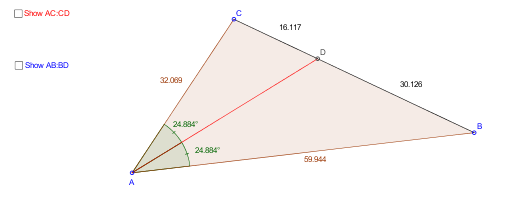
① This GeoGebra example dynamically demonstrates how the angle bisector of a triangle divides the opposite side, creating two smaller triangles that are similar to the original triangle, thereby visualizing the angle bisector theorem. ② Core mathematical concepts include similarity criteria for triangles (two equal angles), the angle bisector property (dividing the opposite side proportionally to adjacent sides), and relationships between angles and segment ratios. ③ Construction highlights: using the Polygon command to create triangle ABC, AngularBisector to draw the bisector of angle A, Intersect to find point D where the bisector meets side BC, Segment to connect AD, Angle to label angles α and β, and text objects to display proportional relationships; key objects include points A, B, C, D, segments a, b, c, d, e, f, g, h, i, j, k, and polygon poligon1. ④ Suitable for upper middle school or high school students to understand triangle similarity and the angle bisector theorem, and useful as an interactive classroom demonstration or for self-guided exploration.
GeoGebra Commands & Parameters
Polygon(A, B, C) → poligon1, c, a, bAngularBisector(B, A, C) → dIntersect(d, a) → DSegment(A, D) → eSegment(B, D) → fSegment(D, C) → gAngle(B, A, D) → αAngle(D, A, C) → β