
Martini Glass Volumes: Exploring Cone Volume and Exponential Functions
Loading the math board and drawing, please wait…
In collections
Geometry - Area & Volume
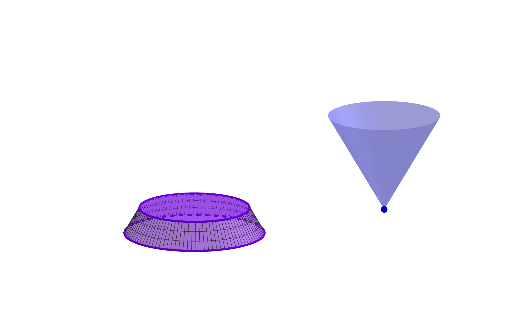
This example demonstrates the relationship between the volume of Martini glass and exponential functions. Key mathematical concepts include the formula for cone volume, exponential growth patterns, and proportional relationships. Construction involves using GeoGebra commands for cone creation, volume calculation, function plotting, and proportional transformations. Suitable for high school students or college freshmen learning solid geometry and function applications.
GeoGebra Commands & Parameters
Polygon(A, B, 3) → poly1, f, g, h, CPolygon(D, E, 3) → poly2, i, j, k, FIntersect(eq1, f) → GIntersect(eq2, i) → HVector(G, C) → uIntersect(p, h) → JIntersect(p, g) → KSegment(G, I) → lVector(F, H) → vSegment(L, F) → mIntersect(q, j) → NIntersect(q, k) → OSegment(L, O) → nCircle(M, n, xOyPlane) → dCone(d, (-m)) → e, r, oCircle(P, 1, xOyPlane) → tCone(t, (-s)) → w, c_1, a_1Circle(G, 1) → d_1Segment(I, K) → f_1Circle(R, f_1, xOyPlane) → e_1Segment(S, T) → g_1Line(G, R) → h_1Surface(g_1, (2 * pi), h_1) → b_1LaTeX(c, true, true) → text1Polygon(A, J, K, B) → q1, a_2, j_2, k_1, b_2Polygon(N, O, F) → t1, f_2, n_1, o_1
AI Drawing Prompt Reference
Draw a martini glass shape with a transparent cup body and stem. The cup body consists of an inverted conical container with a circular bottom and an open top. On the side of the cup body, there is a rotational surface extending from the bottom to the rim, showing an exponential growth curve. The stem is connected to the outside of the cup body through an inclined three-dimensional geometric shape. Display text labels showing the cone volume formula and exponential function relationship. The overall composition demonstrates solid geometry combined with function graphs.
The prompt above was compiled from the original drawing commands and is for reference only.