
Lucas Spiral: Iterative Construction with Similar Triangles and Trigonometry
Loading the math board and drawing, please wait…
In collections
EQUILATERAL TRIANGLE SPIRAL
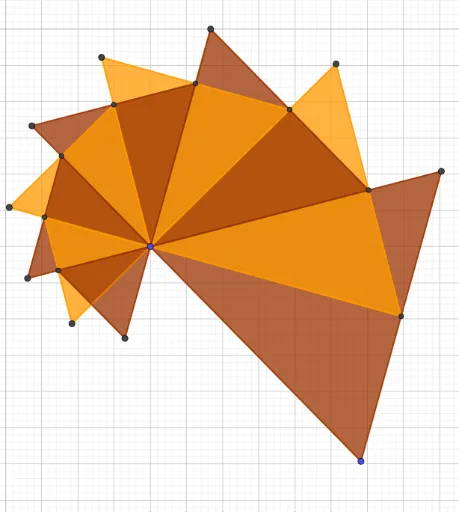
This GeoGebra example demonstrates a spiral pattern formed by iteratively constructing similar triangles, known as the 'Lucas Spiral'. It visually shows how repeated similarity transformations—combining scaling and rotation—create a continuous spiral path. The core mathematical concepts involve similar triangles, trigonometric functions for angle and side calculations, continuity, and straight-line properties within polygons. The construction uses GeoGebra commands such as Polygon to create initial triangles, Midpoint to locate midpoints, and Intersect to find intersection points, generating multiple triangles (poly1 to poly7) and auxiliary segments (f to t) in sequence. This example is suitable for high school or early college students exploring geometric transformations, similarity, and trigonometry in dynamic visualizations, and serves as an engaging introduction to mathematical art and fractal-like patterns.
GeoGebra Commands & Parameters
Polygon(A, B, 3) → poly1, f, g, h, CMidpoint(g) → DPolygon(A, D, 3) → poly2, i, j, k, EIntersect(j, h) → GPolygon(A, G, 3) → poly3, l, m, n, HIntersect(k, m) → IPolygon(A, I, 3) → poly4, p, q, r, JIntersect(n, q) → KPolygon(A, K, 3) → poly5, s, t, a, LIntersect(r, t) → MPolygon(A, M, 3) → poly6, b, c, d, NIntersect(f, a) → OIntersect(a, c) → PPolygon(A, P, 3) → poly7, e, f_1, g_1, QIntersect(d, f_1) → RPolygon(A, R, 3) → poly8, h_1, i_1, j_1, SIntersect(g_1, i_1) → TPolygon(A, T, 3) → poly9, k_1, l_1, m_1, F
AI Drawing Prompt Reference
Starting from a common vertex, construct a sequence of equilateral triangles, each sharing that vertex. The first triangle is equilateral; take the midpoint of one of its sides and use it with the starting vertex to form the second triangle. Then, repeatedly find the intersection of a side of the newest triangle with a side of a previous triangle, and use that intersection point with the starting vertex to build the next triangle. This iterative process creates a spiral of similar triangles, each rotated and scaled relative to the previous one, with all triangles connected through shared vertices or intersection points, forming a continuous spiral path.
The prompt above was compiled from the original drawing commands and is for reference only.