
Logarithmic and Exponential Functions with Geometric Constructions
Loading the math board and drawing, please wait…
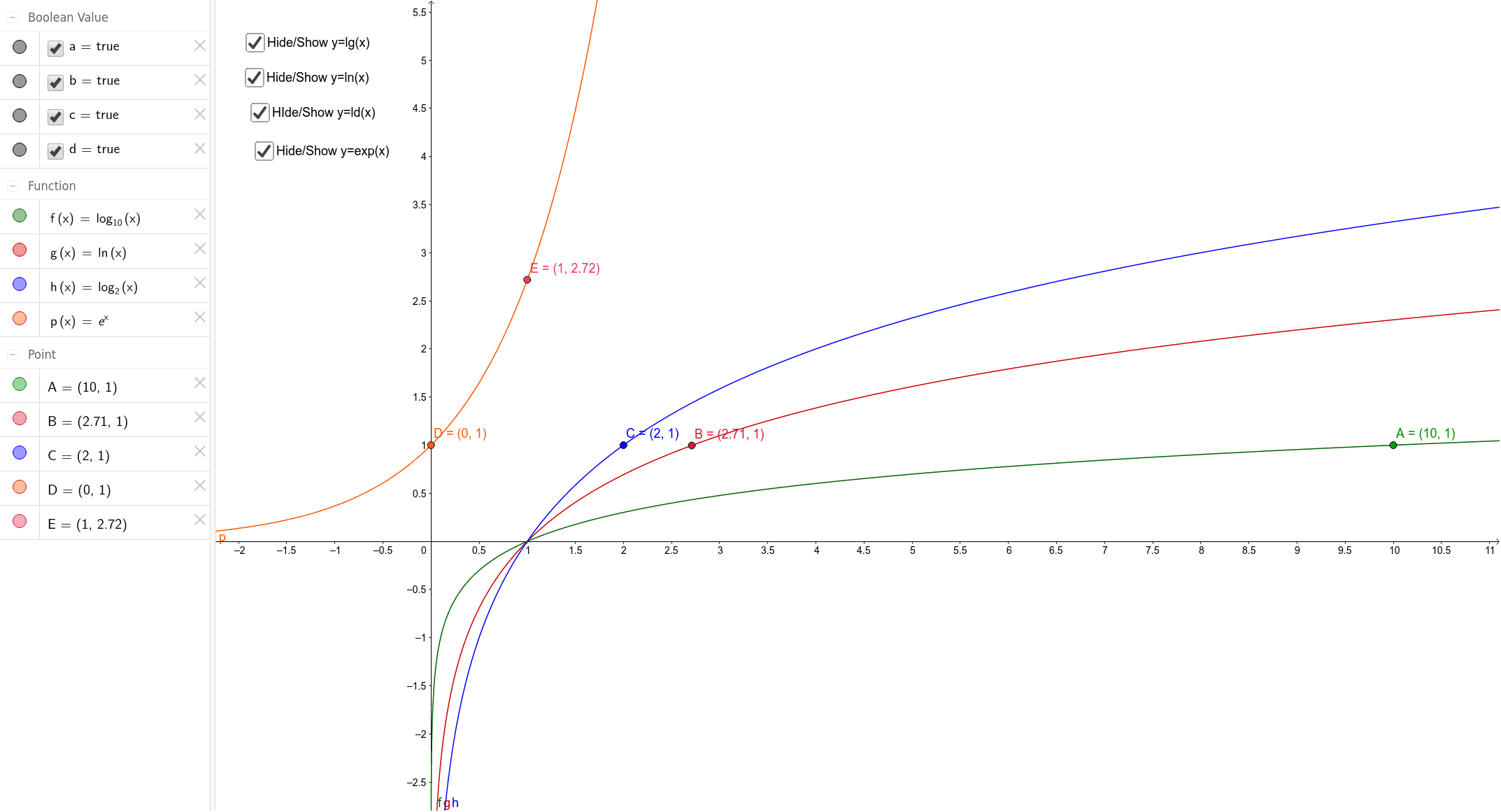
This GeoGebra example demonstrates the graphs of logarithmic and exponential functions alongside related geometric constructions, showing how function properties and geometric shapes interact dynamically. Core mathematical concepts include logarithmic functions, exponential functions, function graph transformations, and the integration of isosceles triangles, rhombi, complex numbers, straight lines, and distributions. The construction uses GeoGebra objects such as functions f, g, h, points A, B, C, D, E, and parameters a, b, c, d, likely with sliders to control parameter values and observe changes in both function graphs and geometric figures. It is suitable for high school and above students to explore the inverse relationship between exponential and logarithmic functions, and for teachers to use in classroom demonstrations or for student-led investigations, enhancing understanding of function behavior and geometric visualization.
GeoGebra Commands & Parameters
f(x) = lg(x)g(x) = log(x)h(x) = ld(x)p(x) = exp(x)(10, lg(10))(2.71, log(2.71))(2, ld(2))(0, exp(0))(1, exp(1))Boolean a(true)Boolean b(true)Boolean c(true)Boolean d(true)
AI Drawing Prompt Reference
Draw a coordinate system containing graphs of logarithmic functions with bases 10, e, and 2, and an exponential function with base e. Mark key points on each curve: the point (10, log10(10)) on the base-10 log, (2.71, ln(2.71)) on the natural log, (2, log2(2)) on the base-2 log, and (0, exp(0)) and (1, exp(1)) on the exponential curve. Include four toggle switches that control the visibility of geometric constructions such as isosceles triangles, rhombi, or complex number representations, which are dynamically linked to the function graphs. The overall layout should be clear and suitable for classroom demonstration, allowing users to observe how function properties and geometric shapes interact.
The prompt above was compiled from the original drawing commands and is for reference only.