
Locus of Double Branch Hyperbola Demo
Loading the math board and drawing, please wait…
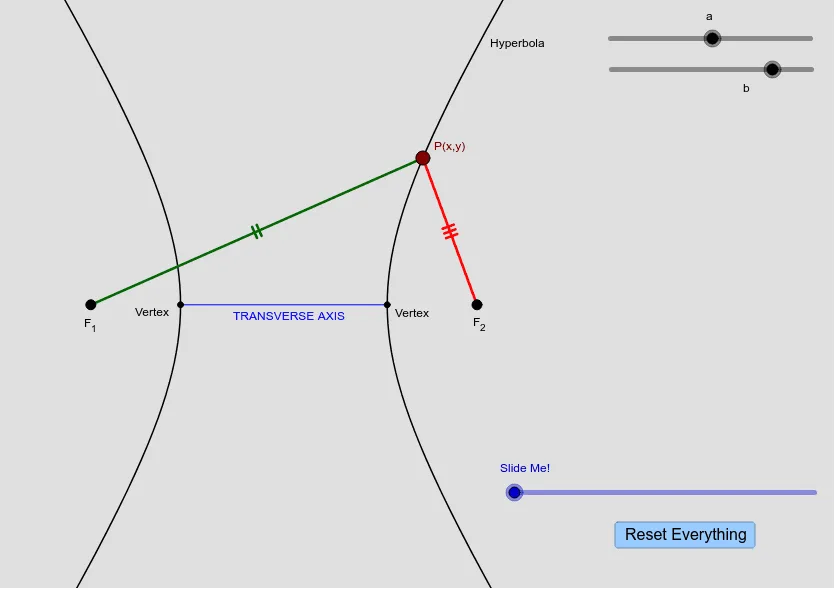
This example demonstrates the locus generation of a double branch hyperbola. It involves core mathematical concepts such as hyperbola definition, foci, vertices, vector transformations, etc. The construction utilizes GeoGebra commands and objects like Focus, Vertex, Segment, Translate, Point, Vector, Dilate, Angle, Rotate, Circle, Intersect, Center as outlined in the summary. Suitable for high school and above students to understand the geometric properties and transformation applications of hyperbolas.
GeoGebra Commands & Parameters
Focus(c) → F_1, F_2Vertex(c) → C, D, E, FSegment(C, D) → dTranslate(C, (0, b + 4)) → C'Translate(D, (0, b + 4)) → D'Point(c) → GSegment(G, F_1) → eSegment(G, F_2) → fTranslate(C, (b + 4, 0)) → C'_1Vector(C, C') → uVector(D, D') → vDilate(C, If[0 < n < 1, 1 - n, 0], C') → C'_2Dilate(D, If[0 < n < 1, 1 - n, 0], D') → D'_2Segment(C'_2, D'_2) → lDilate(F_1, If[1 < n < 2, 2 - n, 1], C') → A'Vector(F_1, A') → wTranslate(G, w) → G'Segment(A', G') → mSegment(C, D) → pAngle(F_2, F_1, G) → αRotate(A', If[1 < n < 2, ((-(2 - n)) * α)], A') → A''Rotate(A', If[1 < n < 2, ((-(n - 2)) * α), 0], A'') → A''_1Rotate(A', If[1 < n < 2, ((-(n - 1)) * α), (-α)], A') → A''_2Rotate(G', If[1 < n < 2, ((-(n - 1)) * α), (-α)], A') → G''Segment(A''_2, G'') → m'Circle(C', e) → qIntersect(q, l, 1) → HSegment(C', H) → rSegment(F_1, G) → sDilate(F_2, If[2 < n < 3, 3 - n, 1], D') → B'Vector(F_2, B') → tTranslate(G, t) → G'_1Translate(G, t) → G'_2Translate(F_2, t) → B'_1Segment(G'_2, B'_1) → f'Angle(G, F_2, F_1) → βSegment(H, D') → a_1Segment(G, F_2) → b_1Center(c) → ADilate(A, If[1 < n < 2, 2 - n, 0], C') → A'_1Vector(F_1, A'_1) → u_1Translate(A, u_1) → A'_2Translate(G, u_1) → G'_3Segment(A'_2, G'_3) → e_1Angle(D, F_1, G) → γRotate(A'_2, ((-(n - 1)) * γ), A'_2) → BRotate(G'_3, ((-(n - 1)) * γ), A'_2) → IDilate(G, If[2 < n < 3, 3 - n, 0], D') → G'_4Vector(G, G'_4) → v_1Translate(A, v_1) → A'_3Translate(G, v_1) → G'_5Segment(A'_3, G'_5) → g_1Rotate(A'_3, If[2 < n < 3, ((-(n - 2)) * γ)], G'_4) → JRotate(G'_5, If[2 < n < 3, ((-(n - 2)) * γ)], G'_4) → KCircle(C', Distance[A''_2, G'']) → k_1Intersect(k_1, i_1, 2) → NSegment(C', N) → j_1Dilate(F_2, If[2 < n < 3, 3 - n], N) → OVector(F_2, O) → w_1Translate(G, w_1) → G'_6Translate(F_2, w_1) → LSegment(G'_6, L) → f'_1Circle(N, f) → p_1Rotate(G'_6, If[2 < n < 3, ((n - 2) * β)], O) → MRotate(L, If[2 < n < 3, ((n - 2) * β)], O) → L'Segment(M, L') → l_1Segment(N, D') → m_1Dilate(C', If[3 < n ≤ 4, 4 - n], C) → C''Dilate(D', If[3 < n ≤ 4, 4 - n], D) → D''Segment(C'', D'') → n_1
AI Drawing Prompt Reference
Draw a double hyperbola locus. First, define the foci F1 and F2, and the vertices C, D, E, F. Then, use transformations like translation, rotation, and scaling to construct the hyperbola's locus. This involves translating points C and D, creating vectors u and v, performing scaling transformations on points C and D, constructing segments, angles, circles, and intersections, and ultimately forming the hyperbola's locus.
The prompt above was compiled from the original drawing commands and is for reference only.