
Locus Center of Parallelogram
Loading the math board and drawing, please wait…
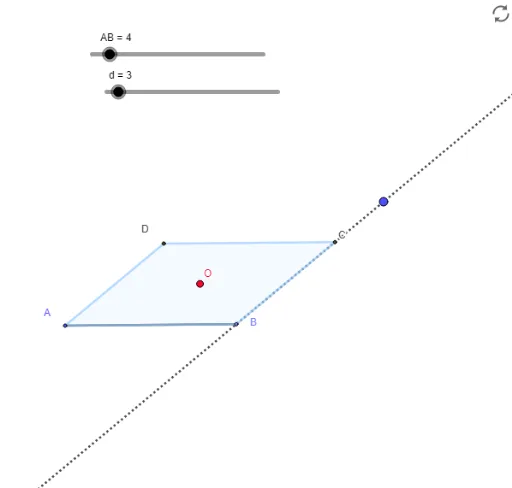
This example demonstrates the locus of the center of a parallelogram. It involves core concepts like parallelogram, centroid, locus, and coordinate geometry. Construction highlights include using GeoGebra commands such as Point, Segment, Line, Circle, Intersect, Polygon, and Centroid. Suitable for high school mathematics education and geometric construction learning.
GeoGebra Commands & Parameters
Point(Circle[A, AB]) → BSegment(A, B) → fLine(B, G) → gCircle(B, d) → cIntersect(c, g, 2) → CLine(C, f) → hLine(A, g) → iIntersect(i, h) → DPolygon(A, B, C, D) → q1, a, b, c_1, d_1Centroid(q1) → O
AI Drawing Prompt Reference
Draw a parallelogram and show the locus of its center. Start by constructing two adjacent sides of the parallelogram, then find the midpoints of these sides and connect them to form the midpoint of the diagonal. Next, draw a circle centered at this midpoint with any radius, intersecting the diagonal's extension at two points. Connect these points to the vertices of the parallelogram to form a new quadrilateral. Finally, find the centroid of this new quadrilateral and trace its path as the parallelogram changes, demonstrating the locus of the center.
The prompt above was compiled from the original drawing commands and is for reference only.