
Locating One Whole on the Number Line v2
Loading the math board and drawing, please wait…
In collections
Fraction Book
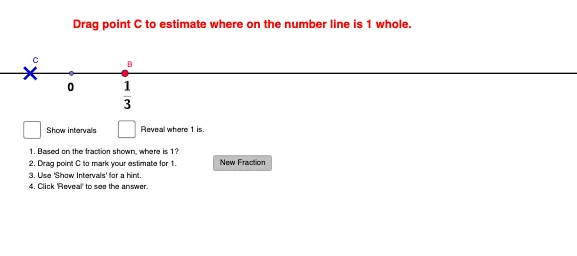
This GeoGebra example dynamically demonstrates where “one whole” (the value 1) is located on a number line relative to randomly generated fractions. The core mathematical concepts covered include the meaning of fractions, numerator and denominator, reduction by greatest common divisor (GCD), number-line representation of points and intervals, and equal partitioning. Construction highlights: the example uses GeoGebra commands Point, Random, Sequence, GCD, and Vector, with key objects such as seednumerator, seeddenominator, distancetoone, intervalsize, list1, finalnumerator, finaldenominator, showintervals, and interaction controls reset and reveal. It is suitable for upper-elementary fraction instruction and middle-school mathematics (rational numbers and fraction operations), supporting classroom demonstration and student-centered inquiry.
GeoGebra Commands & Parameters
Point(a) → ARandom(2, 10) → seeddenominatorRandom(1, seeddenominator - 1) → seednumeratorRandom(5, 15) → distancetooneSequence((x(A) + (intervalsize * i), y(A)), i, 0, 20) → list1GCD(seednumerator, seeddenominator) → reducebyPoint(a) → CVector((x(W), y(W) - 2), (x(W), y(W))) → u
AI Drawing Prompt Reference
Draw a point on a horizontal line as a starting point. Randomly generate two numbers to represent the numerator and denominator of a fraction, then calculate and simplify the fraction using the greatest common divisor. From the starting point, mark multiple points at equal intervals along the number line to form a sequence. Also, show a vector starting from the point and indicate the distance to the value of 1.
The prompt above was compiled from the original drawing commands and is for reference only.