
Locating Fractions on a Number Line by EDC Interactive Math (2)
Loading the math board and drawing, please wait…
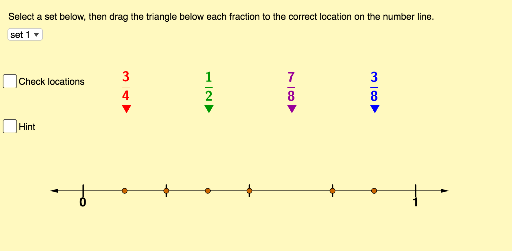
This example helps students understand fractions by moving them to the correct positions on a number line. Key math concepts include fractions, number lines, and feedback. GeoGebra commands used include If, Vector, and Sequence. Suitable for upper elementary and middle school students.
GeoGebra Commands & Parameters
If(set ≟ 1, Frac4PtSet1, If[set ≟ 2, Frac4PtSet2, If[set ≟ 3, Frac4PtSet3, If[set ≟ 4, Frac4PtSet4, If[set ≟ 5, Frac4PtSet5, Frac4PtSet6]]]]) → frac4MasterPtIf(set ≟ 1 ∧ ckPlaceSet1, true, If[set ≟ 2 ∧ ckPlaceSet2, true, If[set ≟ 3 ∧ ckPlaceSet3, true, If[set ≟ 4 ∧ ckPlaceSet4, true, If[set ≟ 5 ∧ ckPlaceSet5, true, If[set ≟ 6 ∧ ckPlaceSet6, true, false]]]]]) → placeMasterYNIf(x(frac4MasterPt) < x(dotA) + snapHorAmt ∧ x(frac4MasterPt) > x(dotA) - snapHorAmt, x(dotA), If[x(frac4MasterPt) < x(dotB) + snapHorAmt ∧ x(frac4MasterPt) > x(dotB) - snapHorAmt, x(dotB), If[x(frac4MasterPt) < x(dotC) + snapHorAmt ∧ x(frac4MasterPt) > x(dotC) - snapHorAmt, x(dotC), If[x(frac4MasterPt) < x(dotD) + snapHorAmt ∧ x(frac4MasterPt) > x(dotD) - snapHorAmt, x(dotD), If[x(frac4MasterPt) < x(dotE) + snapHorAmt ∧ x(frac4MasterPt) > x(dotE) - snapHorAmt, x(dotE), If[x(frac4MasterPt) < x(dotF) + snapHorAmt ∧ x(frac4MasterPt) > x(dotF) - snapHorAmt, x(dotF), If[x(frac4MasterPt) < x(dotG) + snapHorAmt ∧ x(frac4MasterPt) > x(dotG) - snapHorAmt, x(dotG), x(frac4MasterPt)]]]]]]) → frac4XIf(set ≟ 1, Frac3PtSet1, If[set ≟ 2, Frac3PtSet2, If[set ≟ 3, Frac3PtSet3, If[set ≟ 4, Frac3PtSet4, If[set ≟ 5, Frac3PtSet5, Frac3PtSet6]]]]) → frac3MasterPtIf(x(frac3MasterPt) < x(dotA) + snapHorAmt ∧ x(frac3MasterPt) > x(dotA) - snapHorAmt, x(dotA), If[x(frac3MasterPt) < x(dotB) + snapHorAmt ∧ x(frac3MasterPt) > x(dotB) - snapHorAmt, x(dotB), If[x(frac3MasterPt) < x(dotC) + snapHorAmt ∧ x(frac3MasterPt) > x(dotC) - snapHorAmt, x(dotC), If[x(frac3MasterPt) < x(dotD) + snapHorAmt ∧ x(frac3MasterPt) > x(dotD) - snapHorAmt, x(dotD), If[x(frac3MasterPt) < x(dotE) + snapHorAmt ∧ x(frac3MasterPt) > x(dotE) - snapHorAmt, x(dotE), If[x(frac3MasterPt) < x(dotF) + snapHorAmt ∧ x(frac3MasterPt) > x(dotF) - snapHorAmt, x(dotF), If[x(frac3MasterPt) < x(dotG) + snapHorAmt ∧ x(frac3MasterPt) > x(dotG) - snapHorAmt, x(dotG), x(frac3MasterPt)]]]]]]) → frac3XIf(set ≟ 1, Frac2PtSet1, If[set ≟ 2, Frac2PtSet2, If[set ≟ 3, Frac2PtSet3, If[set ≟ 4, Frac2PtSet4, If[set ≟ 5, Frac2PtSet5, Frac2PtSet6]]]]) → frac2MasterPtIf(x(frac2MasterPt) < x(dotA) + snapHorAmt ∧ x(frac2MasterPt) > x(dotA) - snapHorAmt, x(dotA), If[x(frac2MasterPt) < x(dotB) + snapHorAmt ∧ x(frac2MasterPt) > x(dotB) - snapHorAmt, x(dotB), If[x(frac2MasterPt) < x(dotC) + snapHorAmt ∧ x(frac2MasterPt) > x(dotC) - snapHorAmt, x(dotC), If[x(frac2MasterPt) < x(dotD) + snapHorAmt ∧ x(frac2MasterPt) > x(dotD) - snapHorAmt, x(dotD), If[x(frac2MasterPt) < x(dotE) + snapHorAmt ∧ x(frac2MasterPt) > x(dotE) - snapHorAmt, x(dotE), If[x(frac2MasterPt) < x(dotF) + snapHorAmt ∧ x(frac2MasterPt) > x(dotF) - snapHorAmt, x(dotF), If[x(frac2MasterPt) < x(dotG) + snapHorAmt ∧ x(frac2MasterPt) > x(dotG) - snapHorAmt, x(dotG), x(frac2MasterPt)]]]]]]) → frac2XIf(set ≟ 1, Frac1PtSet1, If[set ≟ 2, Frac1PtSet2, If[set ≟ 3, Frac1PtSet3, If[set ≟ 4, Frac1PtSet4, If[set ≟ 5, Frac1PtSet5, Frac1PtSet6]]]]) → frac1MasterPtIf(x(frac1MasterPt) < x(dotA) + snapHorAmt ∧ x(frac1MasterPt) > x(dotA) - snapHorAmt, x(dotA), If[x(frac1MasterPt) < x(dotB) + snapHorAmt ∧ x(frac1MasterPt) > x(dotB) - snapHorAmt, x(dotB), If[x(frac1MasterPt) < x(dotC) + snapHorAmt ∧ x(frac1MasterPt) > x(dotC) - snapHorAmt, x(dotC), If[x(frac1MasterPt) < x(dotD) + snapHorAmt ∧ x(frac1MasterPt) > x(dotD) - snapHorAmt, x(dotD), If[x(frac1MasterPt) < x(dotE) + snapHorAmt ∧ x(frac1MasterPt) > x(dotE) - snapHorAmt, x(dotE), If[x(frac1MasterPt) < x(dotF) + snapHorAmt ∧ x(frac1MasterPt) > x(dotF) - snapHorAmt, x(dotF), If[x(frac1MasterPt) < x(dotG) + snapHorAmt ∧ x(frac1MasterPt) > x(dotG) - snapHorAmt, x(dotG), x(frac1MasterPt)]]]]]]) → frac1XVector((1, 0), (-0.2, 0)) → numLnLVector((1, 0), (2.2, 0)) → numLnRSequence((k - 0.037, -0.25), k, 0, 2, (Element[numLnMax, set] * Element[numLnHash, set])) → labelPtListIf(x(Frac1PtLn) ≤ 2.2 ∧ x(Frac2PtLn) ≤ 2.2 ∧ x(Frac3PtLn) ≤ 2.2 ∧ x(Frac4PtLn) ≤ 2.2 ∧ x(Frac1PtLn) ≥ -0.2 ∧ x(Frac2PtLn) ≥ -0.2 ∧ x(Frac3PtLn) ≥ -0.2 ∧ x(Frac4PtLn) ≥ -0.2 ∧ y(Frac1PtLn) ≟ 0 ∧ y(Frac2PtLn) ≟ 0 ∧ y(Frac3PtLn) ≟ 0 ∧ y(Frac4PtLn) ≟ 0, true, false) → allOnLineIf(x(Frac4PtLn) / Element[numLnMax, set] ≥ Element[frac4Num, set] / Element[frac4Denom, set] - 0.016 ∧ x(Frac4PtLn) / Element[numLnMax, set] ≤ Element[frac4Num, set] / Element[frac4Denom, set] + 0.016, true, false) → frac4PlaceYNIf(x(Frac3PtLn) / Element[numLnMax, set] ≥ Element[frac3Num, set] / Element[frac3Denom, set] - 0.016 ∧ x(Frac3PtLn) / Element[numLnMax, set] ≤ Element[frac3Num, set] / Element[frac3Denom, set] + 0.016, true, false) → frac3PlaceYNIf(x(Frac2PtLn) / Element[numLnMax, set] ≥ Element[frac2Num, set] / Element[frac2Denom, set] - 0.016 ∧ x(Frac2PtLn) / Element[numLnMax, set] ≤ Element[frac2Num, set] / Element[frac2Denom, set] + 0.016, true, false) → frac2PlaceYNIf(x(Frac1PtLn) / Element[numLnMax, set] ≥ Element[frac1Num, set] / Element[frac1Denom, set] - 0.016 ∧ x(Frac1PtLn) / Element[numLnMax, set] ≤ Element[frac1Num, set] / Element[frac1Denom, set] + 0.016, true, false) → frac1PlaceYNIf(set ≟ 1 ∧ ckHintSet1, true, If[set ≟ 2 ∧ ckHintSet2, true, If[set ≟ 3 ∧ ckHintSet3, true, If[set ≟ 4 ∧ ckHintSet4, true, If[set ≟ 5 ∧ ckHintSet5, true, If[set ≟ 6 ∧ ckHintSet6, true, false]]]]]) → hintMasterYNVector(frac3MasterPt + (0.04, -1.5), Frac3PtLn + (0, 0.2)) → Frac3SegVector(frac1MasterPt + (0.04, -1.5), Frac1PtLn + (0, 0.2)) → Frac1SegVector(frac2MasterPt + (0.04, -1.5), Frac2PtLn + (0, 0.2)) → Frac2SegVector(frac4MasterPt + (0.04, -1.5), Frac4PtLn + (0, 0.2)) → Frac4SegSequence(Segment[(i, 0.28), (i, -0.28)], i, 0, 2, (Element[numLnMax, set] * Element[numLnHash, set])) → scaleHashZXaxisIf(set ≟ 1 ∧ ckHintSet1b, true, If[set ≟ 2 ∧ ckHintSet2b, true, If[set ≟ 3 ∧ ckHintSet3b, true, If[set ≟ 4 ∧ ckHintSet4b, true, If[set ≟ 5 ∧ ckHintSet5b, true, If[set ≟ 6 ∧ ckHintSet6b, true, false]]]]]) → hintMasterYNbSequence((0.26 + j, 3.7), j, 0, 1.5, 0.498) → fracAlignPts
AI Drawing Prompt Reference
Draw a number line from -0.2 to 2.2 with a vertical line every unit. Mark the positions of the fractions 1/2, 1/3, 1/4, and 1/5 on the number line, and connect each fraction to its corresponding point with a line segment. Label each fraction point with the fraction. Ensure each fraction point is correctly aligned on the number line, and adjust if necessary. Finally, if needed, show the hint information for each fraction point.
The prompt above was compiled from the original drawing commands and is for reference only.