
Liquid Volume in Cones and Pyramids
Loading the math board and drawing, please wait…
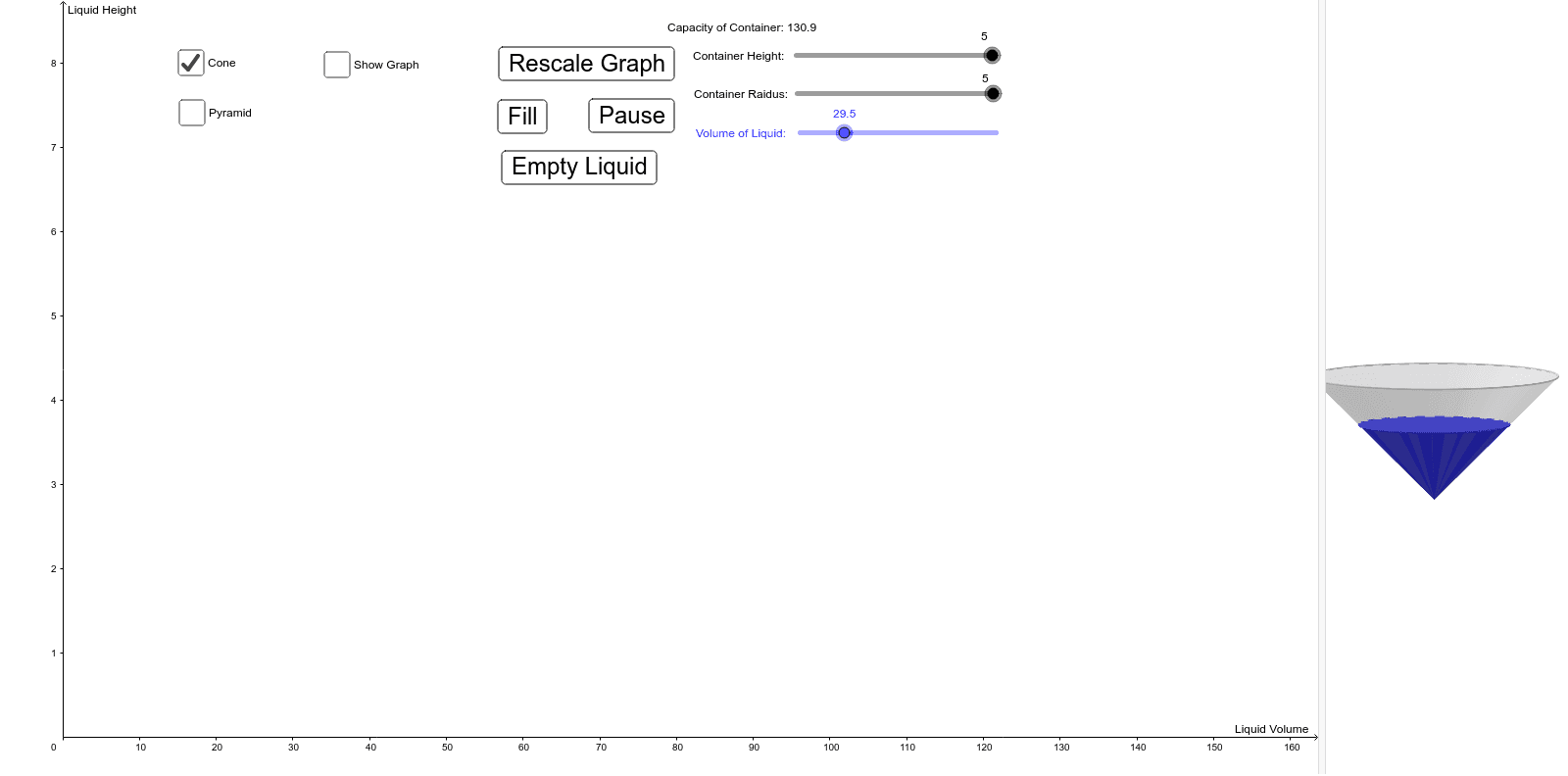
This example investigates the relationship between height and volume in cones and pyramids through the dynamic adjustment of liquid volume. Key mathematical concepts include the volume calculation of cones and pyramids. Using GeoGebra's slider animation, students can observe how the volume of liquid changes as the height of the cones and pyramids is adjusted. Suitable for middle and high school students, this example aids in understanding the volume concepts in solid geometry.
GeoGebra Commands & Parameters
Cone(B, A, contRadius) → a, c, bCone(C, A, liqConeRadius) → d, e, fPyramid(Z, W, X, Y, A) → i, faceWXYZ, edgeAZ, edgeAW, edgeAX, edgeAY, faceAWZ, faceAWX, faceAXY, faceAYZ, edgeWZ, edgeWX, edgeXY, edgeYZPyramid(Y2, Z2, W2, X2, A) → j, faceW2X2Y2Z2, edgeAY2, edgeAZ2, edgeAW2, edgeAX2, faceAY2Z2, faceAW2Z2, faceAW2X2, faceAX2Y2, edgeY2Z2, edgeW2Z2, edgeW2X2, edgeX2Y2
AI Drawing Prompt Reference
Draw a diagram showing the relationship between liquid volume and height in cones and pyramids. Start by creating two cones and a pyramid with a quadrilateral base. Adjust the liquid height dynamically to observe volume changes, labeling key parts like the bases, sides, liquid height, and volume of the cones and pyramid.
The prompt above was compiled from the original drawing commands and is for reference only.