
Linear vs Exponential Growth: Salaries of Adam and Eve
Loading the math board and drawing, please wait…
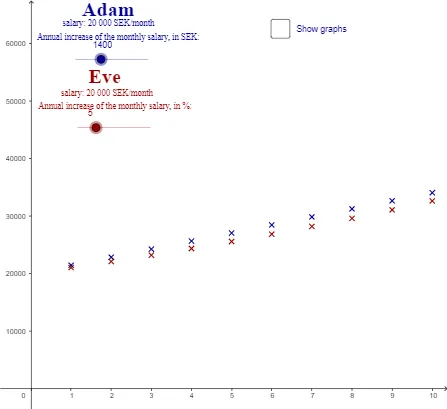
This GeoGebra example compares the salary growth of Adam and Eve to illustrate the fundamental difference between linear and exponential growth. It demonstrates how a linear function (fa) increases by a constant amount, while an exponential function (fe) grows by a constant percentage, leading to dramatically different outcomes over time. The construction uses multiple text objects (text1-text6) for labels, parameters a and b, and generates two sequences of points: A1-A10 for linear growth and E1-E10 for exponential growth, along with auxiliary object c. The function graphs and point sequences visually highlight the accelerating nature of exponential growth versus steady linear progression. This resource is ideal for middle and high school mathematics classes, particularly for teaching functions, sequences, and the practical implications of growth models. It also supports discussions on statistical characteristics and hypothesis testing when comparing real-world data.
GeoGebra Commands & Parameters
Numeric a(1400)Numeric b(5)fa(x) = 20000 + (a * x)fe(x) = (20000 * (1 + b / 100)^(x))(1, fa(1))(2, fa(2))(3, fa(3))(4, fa(4))(5, fa(5))(6, fa(6))(7, fa(7))(8, fa(8))(9, fa(9))(10, fa(10))(1, fe(1))(2, fe(2))(3, fe(3))(4, fe(4))(5, fe(5))(6, fe(6))(7, fe(7))(8, fe(8))(9, fe(9))(10, fe(10))Boolean c(false)
AI Drawing Prompt Reference
Draw a graph comparing linear and exponential growth. The linear part is a straight line that increases by a fixed amount each step. The exponential part is a curve that increases by a fixed percentage each step. Both start from the same point, but the growth patterns differ. Linear growth remains stable, while exponential growth accelerates. Include sequences of points and an auxiliary object.
The prompt above was compiled from the original drawing commands and is for reference only.