
Linear Combination
Loading the math board and drawing, please wait…
In collections
geometriadinamica.es
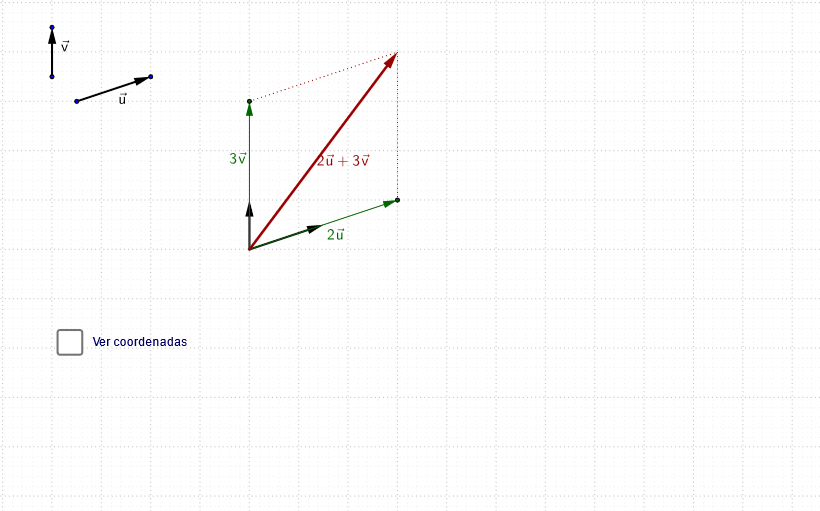
Linear combination is a fundamental concept in mathematics that describes the linear combination of two or more vectors. This GeoGebra example demonstrates how to use linear combination to represent the coordinates of a point. Key mathematical concepts include vector operations and coordinate geometry. Construction points include using Vector, Line, Point, Intersect, Segment, and Distance GeoGebra commands. This example is suitable for middle school or high school students learning linear combination and vector operations.
GeoGebra Commands & Parameters
Vector(A, B) → uVector(C, D) → vVector(O, F) → wVector(O, E) → zLine(O, E) → aLine(O, F) → bPoint(a) → GPoint(b) → HLine(G, b) → cLine(H, a) → d_1Intersect(d_1, c) → IVector(O, H) → eVector(O, G) → fVector(O, I) → gSegment(H, I) → hSegment(I, G) → iDistance(A, B) → muDistance(C, D) → mvDistance(O, G) → mfDistance(O, H) → me
AI Drawing Prompt Reference
Draw a coordinate-geometry diagram in the plane using an origin O. Create three direction vectors by taking vectors from O to two given points (forming u and v) and also from O to two other points (forming w and z). Construct the two lines through O in the directions of the latter points, then place the corresponding points on those lines. Through each constructed point, draw a line using the opposite direction line, and define their intersection as the key point I. Draw the segments between I and the two relevant points (notably H–I and I–G). Finally, construct and label the distances corresponding to the lengths of the initial direction vectors and the distances from O to the main points.
The prompt above was compiled from the original drawing commands and is for reference only.