
Limits Example 1: A Two-Sided Approach
Loading the math board and drawing, please wait…
In collections
BC Calculus
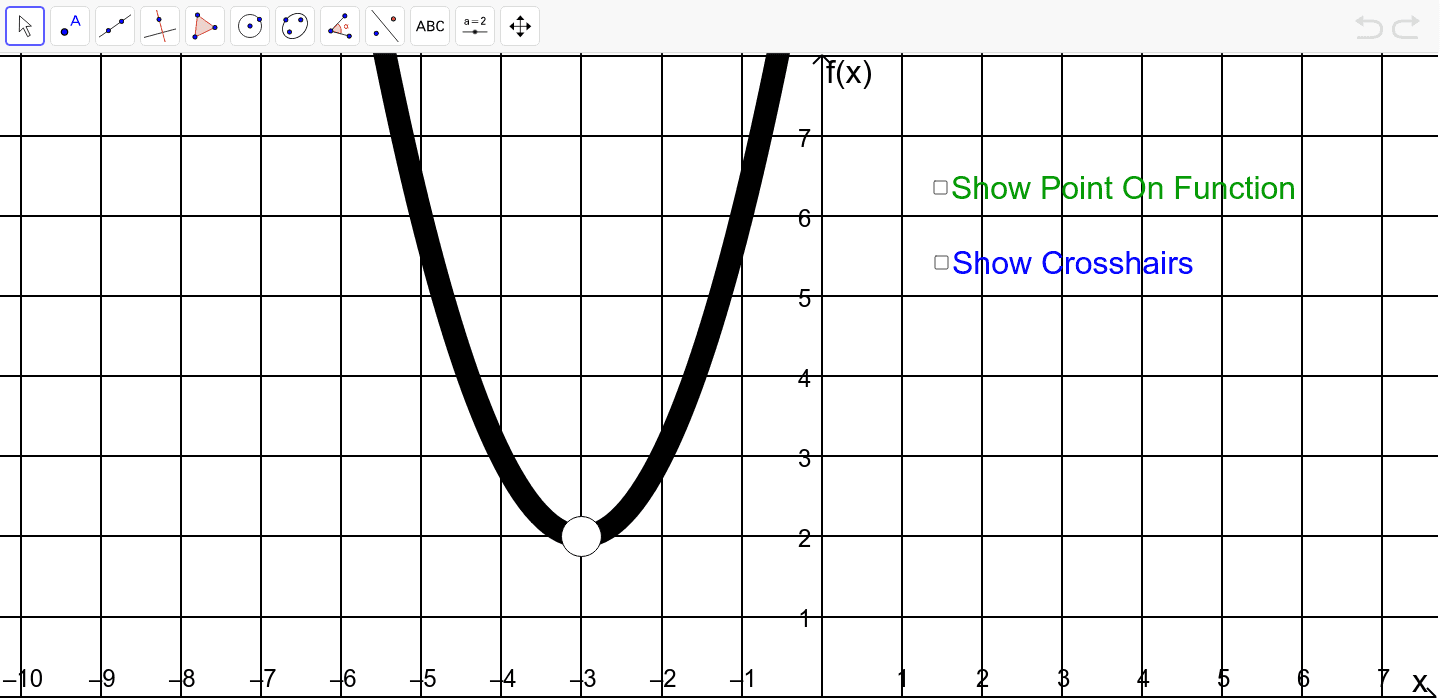
①This example dynamically illustrates the fundamental condition for a function limit to exist at a point: the left-hand limit and right-hand limit must be equal, emphasizing that 'it takes two sides to have a limit'. ②Core mathematical concepts include the two-sided definition of a limit, one-sided limits, and the visualization of discontinuities or piecewise behavior. ③Construction highlights: using GeoGebra commands Point and Segment, the construction involves objects such as function f, points C, D, E, and texts text1 and text2, with a slider t controlling the approach; segments c, d, e and points F, a, b help depict the left and right approaching paths. ④This resource is suitable for high school seniors or early university students learning calculus, serving as an interactive demonstration for teachers or a self-exploration tool for students to grasp the rigorous concept of limits.
GeoGebra Commands & Parameters
Point(f) → CSegment(C, D) → cSegment(E, C) → d
AI Drawing Prompt Reference
Draw a graph of a function with a highlighted point on it. From this point, extend two line segments to the left and right, representing the paths of approach from both sides. Add a slider to control the degree of approach from each side. Label the left and right approaching paths, and include text annotations emphasizing that the limit exists at the point only when the left-hand and right-hand limits are equal. The overall figure visually demonstrates the concept of a two-sided limit.
The prompt above was compiled from the original drawing commands and is for reference only.