
Light Reflection on a Half Cylinder
Loading the math board and drawing, please wait…
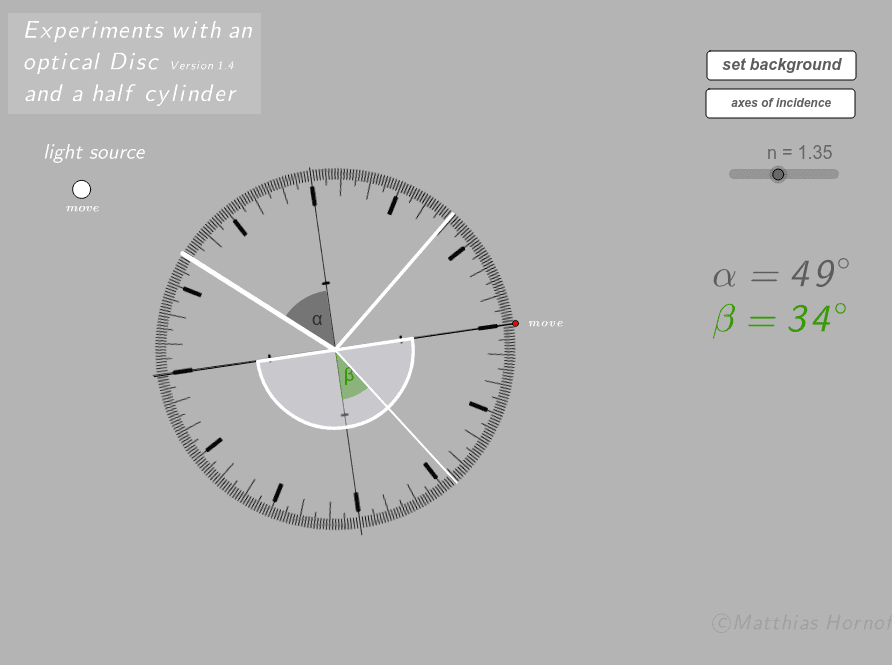
This example demonstrates the reflection of light on a half cylinder. Key mathematical concepts include the law of reflection, ellipses, and similar triangles. Using GeoGebra commands such as Circle, Mirror, Segment, Intersect, etc., a dynamic graphical representation of the reflection is constructed. Suitable for high school mathematics education and learning the law of reflection.
GeoGebra Commands & Parameters
Circle(M, 3.6) → gCircle(M, 6) → ePoint(e) → LqCircle(M, 3.65) → c_1Point(c_1) → AMirror(A, M) → A_1Segment(A, A_1) → aOrthogonalLine(M, a) → lotIntersect(g, lot) → E, FAngle(Lq, M, E) → αIf(α < π / 2, true, false) → obenRotate(Bild1, Angle[B, M, A], M) → Bild1'Point(a) → CMirror(C, M) → C_1CircleSector(M, C_1, C) → d_1Segment(Lq, M) → bIntersect(g, b) → G,OrthogonalLine(G, lot) → hIntersect(h, lot) → HSegment(H, G) → s_1Line(G, H) → iCircle(H, s_1 / n) → kIntersect(k, i) → I, JLine(J, lot) → jIntersect(g, j) → K, LRay(M, L) → lIntersect(e, l) → N,Vector(M, L) → b_1Ray(M, J) → mIntersect(e, m) → O,If(oben ≟ true, Max[π / 2 - Angle[A, M, Lq], Angle[A, M, Lq] - π / 2], Max[(3 * π / 2) - Angle[A, M, Lq], Angle[A, M, Lq] - (3 * π / 2)]) → waAngle(F, M, Lq) → α_uMirror(Lq, lot) → Lq'Mirror(M, lot) → M'Segment(Lq', M') → b'Segment(G, M') → b_2Mirror(G, lot) → G'Mirror(M', lot) → M''Segment(G', M'') → b_3Segment(M', K) → b_4Segment(M', G') → b_5Vector(M', F) → uAngle(u, b_1) → β_oAngle(E, M, K) → β_uSegment(M, L) → dCircleArc(M, C_1, C) → fSegment(C_1, C) → pMax(π / 2 - Angle[L, M, A], Angle[L, M, A] - π / 2) → wbAngle(b_4, b_5) → wb4b5Polygon(H_1, H_2, H_3, H_4) → Vieleck1, d_2, p_1, q, rAngle(Vector[L], Vector[M]) → βAngle(L, M, G') → γ
AI Drawing Prompt Reference
Draw a half-cylinder and demonstrate the reflection of light on its surface. Start by drawing a circle and then a larger circle centered at the intersection point of the first circle with the half-cylinder. Find the intersection points of the first circle with the line perpendicular to the reflected light, and draw the reflected light rays. Utilize geometric properties like similar triangles and ellipses to show the reflection path of light, labeling key angles and reflection points, and present a dynamic representation of light reflection.
The prompt above was compiled from the original drawing commands and is for reference only.