
Lengths in Circles: Two Secants
Loading the math board and drawing, please wait…
In collections
Segment Lengths in Circles - Exploration
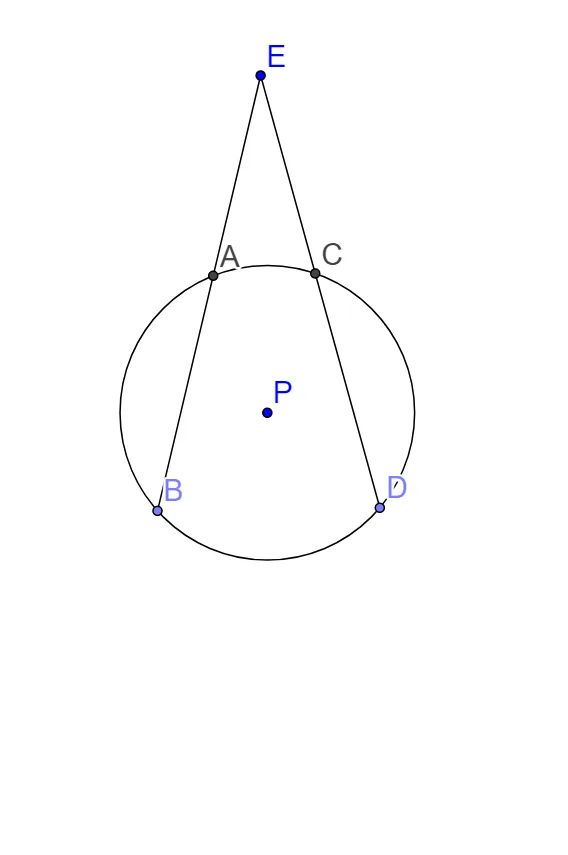
This example demonstrates the relationship between the lengths of two secants intersecting outside a circle and their distances to the center. Key math concepts include the Secant-Secant Theorem, Power of a Point Theorem, and similar triangles. Construction involves commands like Circle, Point, Segment, Intersect, and Distance. Suitable for middle school and above students learning circle geometry and the application of the Secant-Secant Theorem.
GeoGebra Commands & Parameters
Circle(P, 3) → cPoint(c) → BSegment(B, E) → aPoint(c) → DSegment(E, D) → bIntersect(c, a, 2) → AIntersect(c, b, 2) → CDistance(E, A) → EADistance(E, B) → EBDistance(E, C) → ECDistance(E, D) → EDDistance(A, E) → AEDistance(A, B) → ABDistance(C, D) → B6
AI Drawing Prompt Reference
Draw a circle with a center point and radius 3. From a point outside the circle, draw two secant lines that intersect the circle. The first secant starts from the external point, passes through a point on the circle, and meets the circle again at another point. The second secant similarly starts from the same external point, passes through a different point on the circle, and meets the circle again at a fourth point. Connect the external point to each intersection point on the circle, and label the lengths of these segments. The figure shows the two secants and their intersection points with the circle, illustrating the relationship of segment lengths in the secant-secant theorem.
The prompt above was compiled from the original drawing commands and is for reference only.