
Learning Equivalent Fractions
Loading the math board and drawing, please wait…
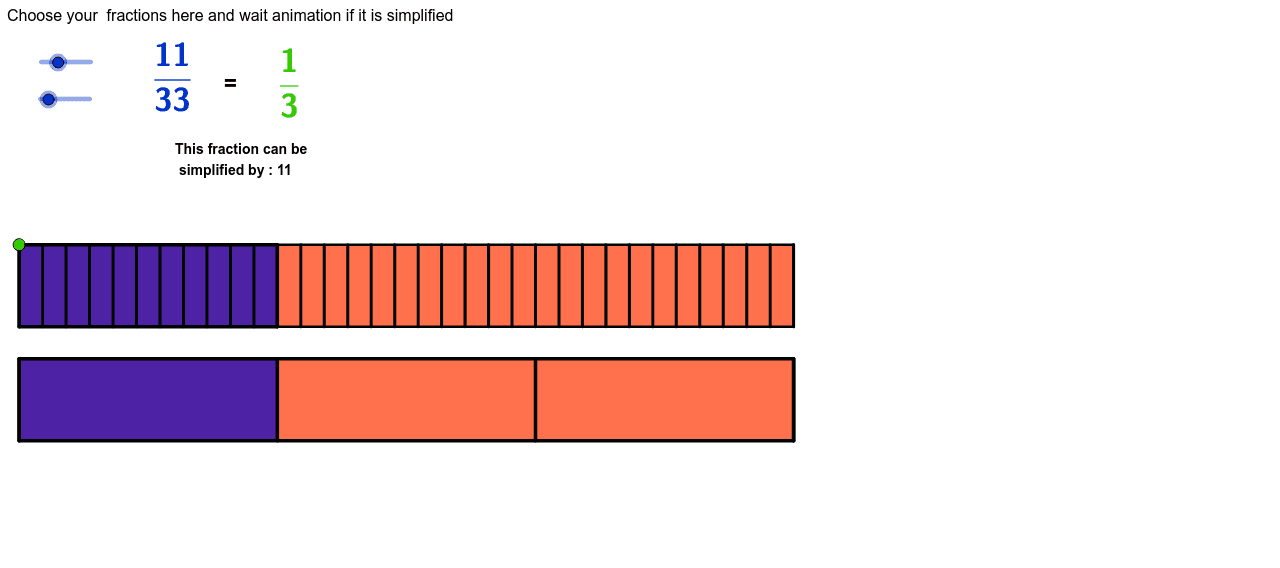
This example demonstrates the concept of equivalent fractions through interactive visualization, showing how different fraction forms can be converted into one another. Key math concepts include the fundamental properties of fractions, simplification and finding common denominators, and the application of the Greatest Common Divisor (GCD). The construction leverages commands like GCD, Segment, Sequence, and objects such as Polygon and Line. It is suitable for middle school and above students to understand fraction equivalence transformations and their practical applications.
GeoGebra Commands & Parameters
GCD(n_1, d_1) → hSegment(A, B) → aRandomNormal(2, 4) → cRandomBinomial(2, 3) → bBinomial(4, 2) → dSequence((x(D) + i * a / d_1, y(D)), i, 0, d_1) → PointbasSequence((x(A) + i * a / d_1, y(A)), i, 0, d_1) → PointhautSequence(Segment[Element[Pointhaut, i], Element[Pointbas, i]], i, 1, d_1 + 1) → liste1Polygon(A, B, C, D) → Total, a_2, b_1, c_1, d_4Polygon(A, D, Element[Pointbas, n_1 + 1], Element[Pointhaut, n_1 + 1]) → Morceau, a_1, d_3, i, jPolygon(E, F, H, G) → poly1, e, f_1, h_1, g_1Sequence((x(G) + i * e / (d_1 / h), y(G)), i, 0, d_1 / h) → L2Sequence((x(E) + i * e / (d_1 / h), y(E)), i, 0, d_1 / h) → L3Sequence(Segment[Element[L3, i], Element[L2, i]], i, 1, d_1 / h + 1) → liste2Polygon(E, G, Element[L2, n_1 / h + 1], Element[L3, n_1 / h + 1]) → poly2, e_1, g, f, kLine(A, yAxis) → lIf(h * h ≟ 1, 0, 5) → Vitesse