
Langley's Problem
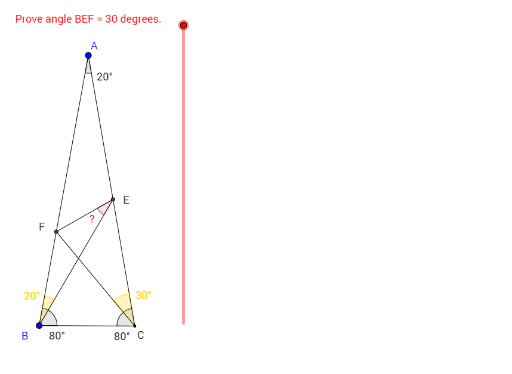
Loading the math board and drawing, please wait…
This example demonstrates Langley's problem, a classic geometric puzzle involving angles and triangles. Using commands like rotation, circle, and polygon, users can explore angle relationships and geometric properties. Suitable for middle and high school students studying geometry and trigonometry.
GeoGebra Commands & Parameters
Rotate(B, 20°, A) → CCircle(A, B) → c_2Polygon(A, B, C) → poly1, c, a, bIntersect(Line[C, Rotate[A, 30°, C]], c) → FIntersect(Line[B, Rotate[A, -20°, B]], b) → ESegment(F, E) → fSegment(B, E) → gSegment(C, F) → hAngle(B, A, C) → BACAngle(C, B, A) → CBAAngle(A, C, B) → ACBAngle(E, B, F) → EBFAngle(E, C, F) → ECFIntersect(Line[B, Rotate[C, 20°, B]], b) → GSegment(B, G) → iSegment(G, F) → jAngle(G, B, F) → GBFAngle(G, B, E) → GBEAngle(B, E, G) → BEGAngle(E, G, F) → FGEAngle(C, B, G) → CBGSegment(B, C) → kSegment(B, G) → lSegment(B, F) → mSegment(G, E) → nAngle(F, E, C) → GEFAngle(F, E, B) → BEFAngle(F, E, B) → FEB