
Lagrange Multipliers Example 2
Loading the math board and drawing, please wait…
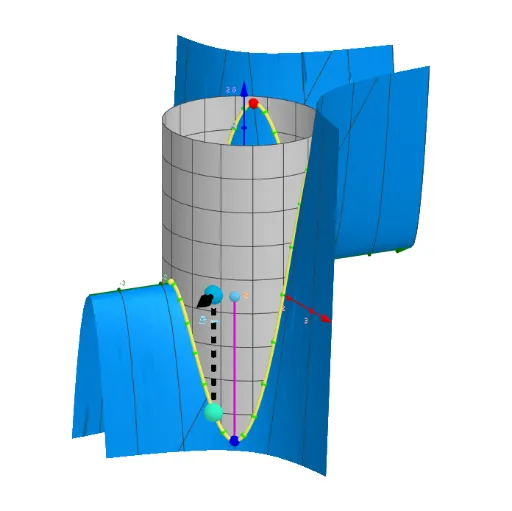
This example demonstrates solving constrained optimization problems using the method of Lagrange multipliers, visually illustrating the relationship between the objective function and the constraint. Key mathematical concepts include Lagrange multipliers, partial derivatives, gradients, and the geometric interpretation of the objective and constraint functions. The construction utilizes GeoGebra commands and objects such as LeftSide, Simplify, Point, UnitVector, Angle, LaTeX, Textfield, Zip, CurveCartesian, Surface, RotateText, Sequence, RemoveUndefined, Text, TableText, and Segment. It is suitable for university-level mathematics and engineering courses focusing on applying calculus to solve practical optimization problems.
GeoGebra Commands & Parameters
LeftSide(Cu_g) → gSimplify(Derivative[g, x, 1]) → gx'Simplify(Derivative[g, y, 1]) → gy'Simplify(Derivative[f, x, 1]) → fx'Simplify(Derivative[f, y, 1]) → fy'Point(Cu_g) → BUnitVector(Vector[B, Dg]) → u_gUnitVector(Vector[B, Df]) → u_fAngle(u_g, u_f) → αLaTeX(f, true) → text8aLaTeX(Cu_g, true) → text8bTextfield(Cu0_x) → InputBox1Textfield(Cu0_y) → InputBox2Textfield(f) → InputBox3Textfield(Cu_g) → InputBox4Zip((x(a), y(a), f(a)), a, Sequence[Point[Cu_g, t / n], t, 0, n]) → lg_1Textfield(n) → InputBox5Zip("(" + (LaTeX[ScientificText[x(a), 2]]) + "," + (LaTeX[ScientificText[y(a), 2]]) + ")", a, l1xy'_f) → l1xy'_faCurveCartesian((sqrt(3) * cos(t)), (sqrt(3) * sin(t)), f((sqrt(3) * cos(t)), (sqrt(3) * sin(t))), t, (-π), π) → q1Surface((sqrt(3) * cos(t)), (sqrt(3) * sin(t)), u, t, (-π), π, u, -2.1, 2.1) → g1RotateText(text15, 90°) → text20Zip(Text["(" + (SurdText[x(a)]) + "," + (SurdText[y(a)]) + ")", (0, 0), true, true], a, l1) → l1surdZip(Text["(" + (SurdText[x(a)]) + "," + (SurdText[y(a)]) + ")", (0, 0), true, true], a, l2) → l2surdSequence(If[lα1(i) ≟ 180°, 1, lα1(i) ≟ 0°, 2, 3], i, 1, Length[l1]) → l1_αSequence(If[lα2(i) ≟ 180°, 1, lα2(i) ≟ 0°, 2, 3], i, 1, Length[l2]) → l2_αRemoveUndefined(Sequence[If[l1_α(i) ≟ 1, l1(i), NaN], i, 1, Length[l1]]) → l1minRemoveUndefined(Sequence[If[l1_α(i) ≟ 2, l1(i), NaN], i, 1, Length[l1]]) → l1maxRemoveUndefined(Sequence[If[l1_α(i) ≟ 3, l1(i), NaN], i, 1, Length[l1]]) → l1loc1RemoveUndefined(Sequence[If[l1_α(i) ≟ 1, l1f(i), NaN], i, 1, Length[l1f]]) → l1min_{3D}RemoveUndefined(Sequence[If[l1_α(i) ≟ 2, l1f(i), NaN], i, 1, Length[l1f]]) → l1max_{3D}RemoveUndefined(Sequence[If[l2_α(i) ≟ 2, l2(i), NaN], i, 1, Length[l2]]) → l2maxRemoveUndefined(Sequence[If[l2_α(i) ≟ 2, l2f(i), NaN], i, 1, Length[l2f]]) → l2max_{3D}RemoveUndefined(Sequence[If[l2_α(i) ≟ 1, l2(i), NaN], i, 1, Length[l2]]) → l2minRemoveUndefined(Sequence[If[l2_α(i) ≟ 1, l2f(i), NaN], i, 1, Length[l2f]]) → l2min_{3D}Text("∇f", Point[u_f, 1]) → text25Text("∇g", Point[u_g, 1]) → text25gTableText(Append["N", 1…Length[l1]], Append["\fgcolor{red}{Cp}", l1surd], Append["\fgcolor{blue}{f}(\fgcolor{red}{C_p })", l1fa], Append["(\dot{f_x},\dot{f_y})", l1xy'_fa], Append["(\dot{g_x},\dot{g_y})", l1xy'_ga], Append["λ_x", lλ1ax], Append["λ_y", lλ1ay], Append["\widehat{\dot{g}\dot{f}} ", lα1], "c|_") → tTab1TableText(Append["N", 1…Length[l2]], Append["\fgcolor{red}{Cp}", l2surd], Append["\fgcolor{blue}{f}(\fgcolor{red}{C_p })", l2fa], Append["(\dot{f_x},\dot{f_y})", l2xy'_fa], Append["(\dot{g_x},\dot{g_y})", l2xy'_ga], Append["λ_x", lλ2ax], Append["λ_y", lλ2ay], Append["\widehat{\dot{g}\dot{f}} ", lα2], "c|_") → tTab2Segment(B, C) → f_1RemoveUndefined(Zip[Vector[c, c + UnitVector[a]], a, l1xy'_f, c, l1]) → lvec1_fRemoveUndefined(Zip[Vector[c, c + UnitVector[a]], a, l1xy'_g, c, l1]) → lvec1_gRemoveUndefined(Zip[Vector[c, c + UnitVector[a]], a, l2xy'_f, c, l2]) → lvec2_fRemoveUndefined(Zip[Vector[c, c + UnitVector[a]], a, l2xy'_g, c, l2]) → lvec2_gZip(Segment[a, b], a, l1, b, l1f) → l1segSequence(Text[i, l1(i) + (0.2, 0.1)], i, 1, lä1) → l1txtSequence(Text[i, l2(i) + (0.2, 0.1)], i, 1, lä2) → l2txtZip(Segment[a, b], a, l2, b, l2f) → l2seg
AI Drawing Prompt Reference
Create a 3D illustration of a constrained optimization problem: a cylindrical surface as the constraint, with a space curve on it representing the objective function values. Place multiple sample points on the surface, and at each point draw gradient vectors for both the objective and constraint functions, marking the angle between them. Show the projection of the objective curve onto the constraint, along with vertical segments connecting surface points to their planar counterparts. Include a table listing coordinates, function values, gradient components, and angles, using colors to distinguish maxima, minima, and saddle points.
The prompt above was compiled from the original drawing commands and is for reference only.