
Kite Exploration: Diagonals, Angles, and Geometric Transformations
Loading the math board and drawing, please wait…
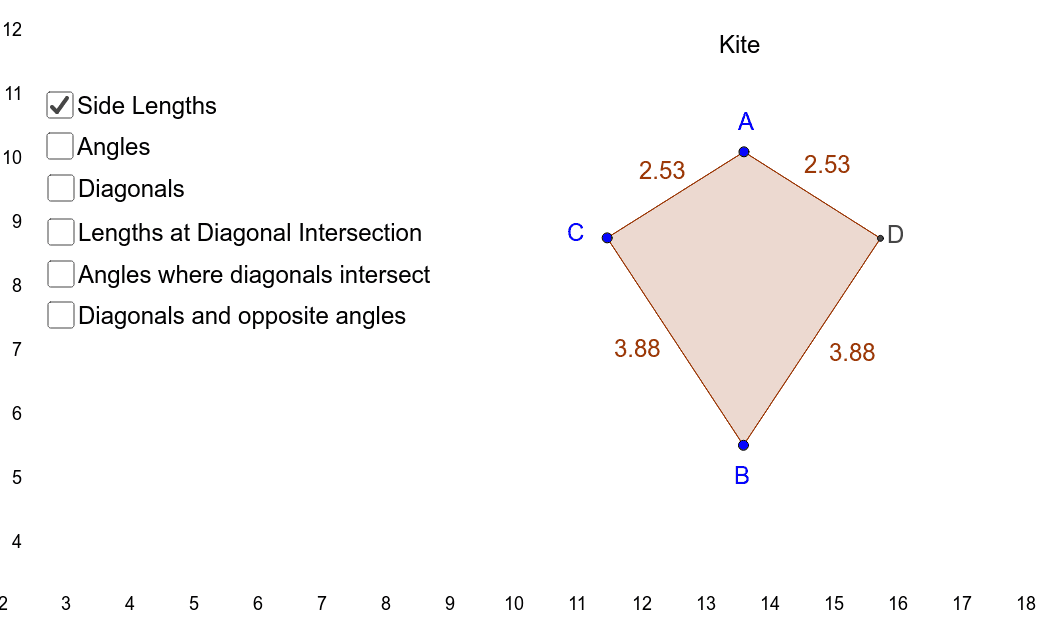
This GeoGebra example presents an interactive exploration of a kite quadrilateral, demonstrating its defining properties and dynamic behavior. The core mathematical concepts include the kite definition (two pairs of adjacent equal sides), perpendicular diagonals with one bisecting the other, symmetry axis, interior angle sums, and extensions to secant lines or Riemann sums for approximating areas. The construction uses commands such as Line, OrthogonalLine, Circle, Intersect, Polygon, Angle, and Segment, creating points A, B, C, D, polygon poly1, diagonals e and f with intersection E, and measuring side lengths, angles (α, β, γ, δ), and lengths/angles at the diagonal intersection (ε, ζ, η), along with text labels and auxiliary segments. This resource is suitable for middle school to college geometry courses, enabling students to verify kite properties, explore geometric transformations (symmetry, rotation), and visualize connections to calculus concepts like upper/lower sums or Riemann sums. It serves as a versatile tool for inquiry-based learning and dynamic geometry demonstrations.
GeoGebra Commands & Parameters
Line(A, B) → aOrthogonalLine(C, a) → bCircle(A, C) → cIntersect(c, b, 2) → DPolygon(C, A, D, B) → poly1, c_1, a_1, d, b_1Polygon(A, D, B, C) → poly2, a_2, d_1, b_2, c_2Angle(C, A, D) → αAngle(A, D, B) → βAngle(B, C, A) → γAngle(D, B, C) → δSegment(A, B) → eSegment(C, D) → fIntersect(e, f) → ESegment(E, C) → gSegment(E, A) → hSegment(E, D) → iSegment(E, B) → jSegment(C, D) → lSegment(A, B) → mIntersect(l, m) → FAngle(D, F, A) → εAngle(A, F, C) → ζAngle(C, F, B) → ηAngle(B, F, D) → θSegment(C, D) → kSegment(A, B) → nAngle(D, C, A) → ιAngle(B, C, D) → κAngle(A, B, C) → λAngle(D, B, A) → μAngle(C, A, B) → νAngle(B, A, D) → ξAngle(A, D, C) → οAngle(C, D, B) → ρ
AI Drawing Prompt Reference
Draw a kite with points A, B, C, and D, where AB and CD are equal in length, and AC and BD are perpendicular, with AC bisecting BD. Construct the two diagonals AC and BD, which intersect at point E, and measure the four interior angles α, β, γ, δ, as well as the angles ε, ζ, η at the intersection of the diagonals. Finally, draw auxiliary segments such as AE, BE, CE, and DE to help understand the kite's symmetry and angle relationships.
The prompt above was compiled from the original drawing commands and is for reference only.