
Japanese Theorem for Cyclic Polygons
Loading the math board and drawing, please wait…
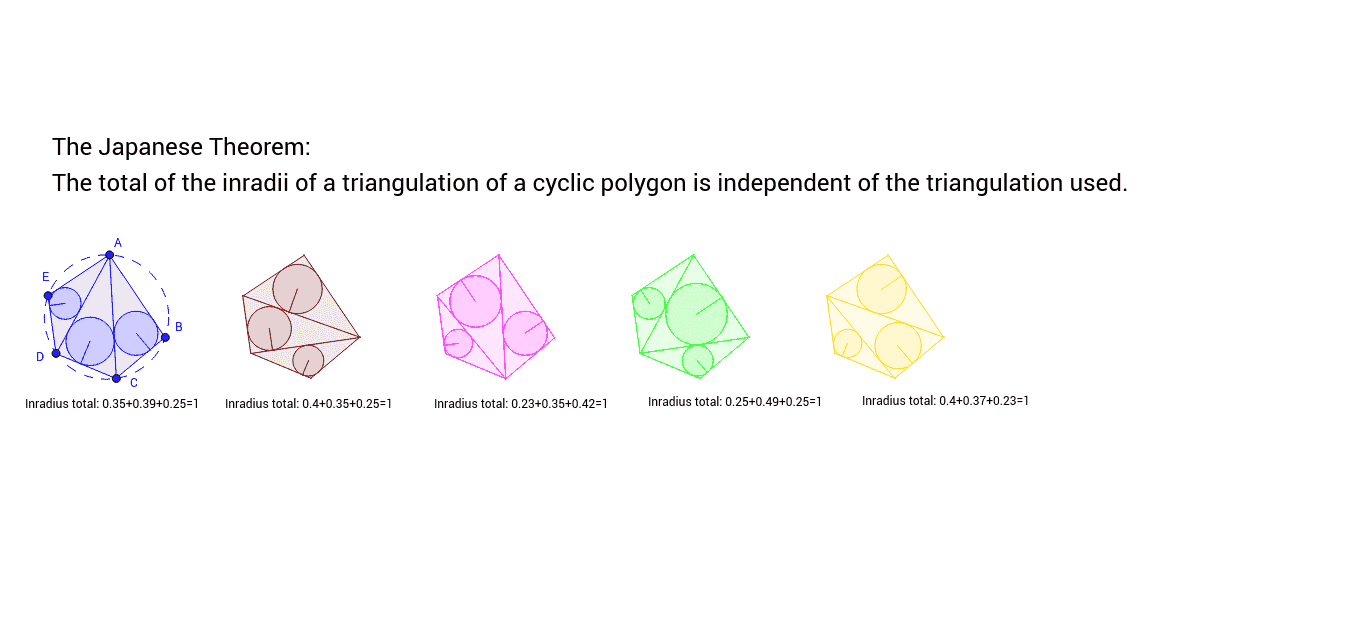
This example illustrates the Japanese Theorem for cyclic polygons, which states that the sum of the radii of the incircles of a cyclic polygon is a constant. Key concepts include polygons, incircles, and geometric construction. Commands used include Vector, Circle, Point, Polygon, Translate, Segment, and Incenter. Suitable for high school mathematics education and learning.
GeoGebra Commands & Parameters
Vector(P, Q) → uCircle(O, 1) → cPoint(c) → APoint(c) → BPoint(c) → CPoint(c) → DPoint(c) → EPolygon(A, B, C, D, E) → poly1, a, b, c_1, d, eTranslate(A, u) → A'Translate(B, u) → B'Translate(C, u) → C'Translate(D, u) → D'Translate(E, u) → E'Polygon(A', B', C', D', E') → poly1', a', b', c', d', e'Translate(A', u) → A''Translate(B', u) → B''Translate(C', u) → C''Translate(D', u) → D''Translate(E', u) → E''Polygon(A'', B'', C'', D'', E'') → poly1'', a'', b'', c'', d'', e''Translate(A'', u) → A'''Translate(B'', u) → B'''Translate(C'', u) → C'''Translate(D'', u) → D'''Translate(E'', u) → E'''Polygon(A''', B''', C''', D''', E''') → poly1''', a''', b''', c''', d''', e'''Translate(A''', u) → FTranslate(B''', u) → GTranslate(C''', u) → HTranslate(D''', u) → ITranslate(E''', u) → JPolygon(F, G, H, I, J) → poly2, f, g, h, i, jSegment(A, D) → kSegment(A, C) → lSegment(B', E') → mSegment(B', D') → nSegment(C'', A'') → pSegment(C'', E'') → qSegment(D''', B''') → rSegment(D''', A''') → sSegment(J, H) → tSegment(J, G) → a_1Incenter(A, B, C) → d_1, b_1, K, LIncenter(A, C, D) → e_1, f_1, M, NIncenter(A, D, E) → g_1, h_1, R, SIncenter(A', E', B') → k_1, i_1, T, UIncenter(E', D', B') → p_1, j_1, V, WIncenter(B', D', C') → q_1, l_1, Z, A_1Incenter(C'', A'', B'') → r_1, m_1, B_1, C_1Incenter(C'', E'', A'') → s_1, n_1, D_1, E_1Incenter(C'', D'', E'') → t_1, a_2, F_1, G_1Incenter(D''', E''', A''') → c_2, b_2, H_1, I_1Incenter(D''', A''', B''') → d_2, e_2, J_1, K_1Incenter(D''', B''', C''') → f_2, g_2, L_1, M_1Incenter(J, G, F) → h_2, i_2, N_1, O_1Incenter(J, H, G) → k_2, j_2, P_1, Q_1Incenter(J, I, H) → p_2, l_2, R_1, S_1
AI Drawing Prompt Reference
Draw a cyclic pentagon where the sum of the radii of the incircles is constant. Start by placing five points A, B, C, D, and E on a circle and connecting them to form a pentagon. Then translate each point three times along vector u to form a new pentagon. Next, connect corresponding vertices of the original and translated pentagons, and connect adjacent vertices of the original pentagon. Finally, find the incenter of each triangle formed by the original pentagon, which will form a new pentagon.
The prompt above was compiled from the original drawing commands and is for reference only.