
Isosceles Triangles - Examples and Non-Examples by Sergio lazo
Loading the math board and drawing, please wait…
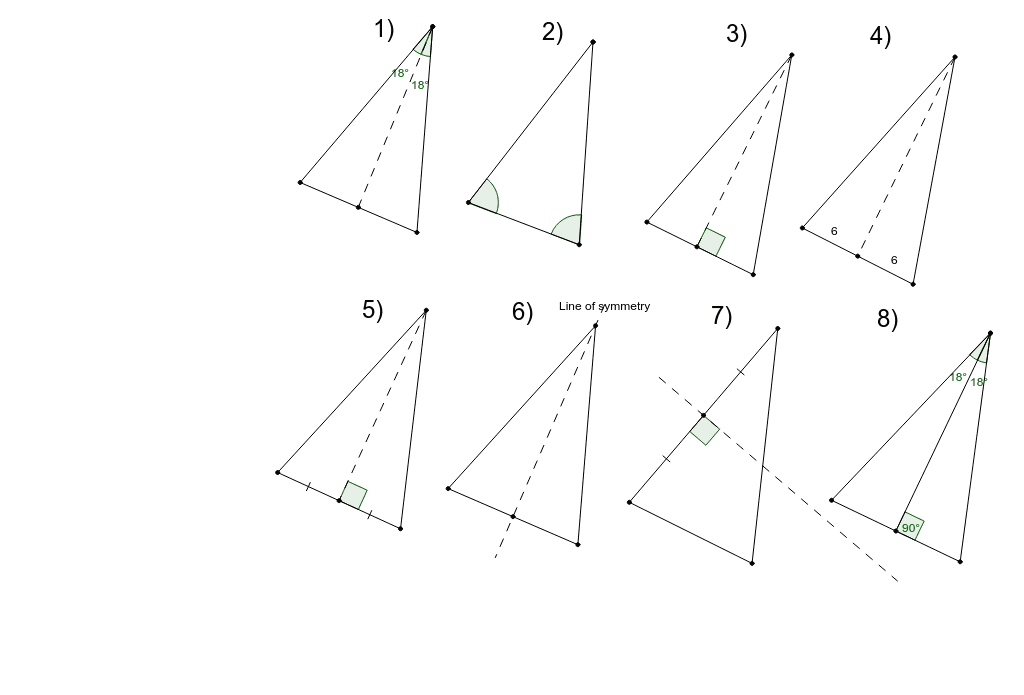
This example dynamically demonstrates the definition and distinction of isosceles triangles from non-isosceles ones. Core concepts include properties of isosceles triangles, angle bisectors, symmetry, and linear regression. GeoGebra commands and objects like Rotate, Angle, Segment, Point, Ray, AngularBisector, Intersect, Mirror, OrthogonalLine, Midpoint, and Circle are used in construction. Suitable for high school mathematics education to enhance understanding and identification of isosceles triangle properties.
GeoGebra Commands & Parameters
Rotate(A, 36*°, B) → A'Angle(A, B, A') → αSegment(C, D) → aRotate(C, α, D) → C'Rotate(D, α, D) → D'Segment(C', D') → a'Point(a') → ERay(D, E) → bPoint(b) → FSegment(C, F) → cAngularBisector(C, D, F) → dIntersect(d, c) → GSegment(D, G) → eSegment(D, F) → fAngle(C, D, G) → βAngle(G, D, F) → γSegment(H, I) → gSegment(H, J) → hMirror(H, g) → H'Mirror(J, g) → J'Segment(H', J') → h'Segment(J, J') → iAngle(J', J, H) → δAngle(H, J', J) → εSegment(K, L) → jSegment(L, M) → kSegment(M, K) → lOrthogonalLine(L, l) → mIntersect(m, l) → NSegment(L, N) → nAngle(M, N, L) → ζPoint(Circle[O, 2.5]) → PSegment(O, P) → pMidpoint(O, P) → QSegment(O, R) → qSegment(R, P) → rSegment(R, Q) → sSegment(S, T) → tMidpoint(S, T) → UOrthogonalLine(U, t) → a_1Point(a_1) → VSegment(S, V) → b_1Segment(V, T) → c_1Segment(V, U) → d_1Segment(W, Z) → e_1Midpoint(e_1) → A_1OrthogonalLine(A_1, e_1) → f_1Point(f_1) → B_1Segment(W, B_1) → g_1Segment(B_1, Z) → h_1Point(f_1) → C_1Point(f_1) → D_1Segment(C_1, D_1) → i_1Segment(E_1, F_1) → j_1Circle(G_1, 0.3) → k_1Midpoint(S, U) → H_1Point(k_1) → J_1Segment(G_1, J_1) → l_1Circle(H_1, l_1) → p_1OrthogonalLine(H_1, t) → m_1Intersect(p_1, m_1, 2) → K_1Intersect(p_1, m_1, 1) → L_1Segment(S, U) → q_1Segment(U, T) → r_1Midpoint(F_1, E_1) → I_1OrthogonalLine(I_1, j_1) → n_1Segment(F_1, I_1) → s_1Segment(I_1, E_1) → t_1Segment(E_1, M_1) → a_2Segment(M_1, F_1) → b_2Point(n_1) → N_1Point(n_1) → O_1Segment(N_1, O_1) → c_2Angle(F_1, I_1, O_1) → ηRotate(A_2, 36*°, B_2) → A'_1Angle(A_2, B_2, A'_1) → α_1Segment(C_2, D_2) → a_3Rotate(C_2, α_1, D_2) → C'_1Rotate(D_2, α_1, D_2) → D'_1Segment(C'_1, D'_1) → a'_1Point(a'_1) → E_2Ray(D_2, E_2) → b_3Point(b_3) → F_2Segment(C_2, F_2) → c_3AngularBisector(C_2, D_2, F_2) → d_2Intersect(d_2, c_3) → G_2Segment(D_2, G_2) → e_2Segment(D_2, F_2) → f_2Angle(C_2, D_2, G_2) → β_1Angle(G_2, D_2, F_2) → γ_1OrthogonalLine(C_2, e_2) → g_2Intersect(g_2, f_2) → P_1Segment(D_2, P_1) → h_2Midpoint(C_2, P_1) → Q_1Segment(C_2, P_1) → i_2Segment(Q_1, D_2) → j_2Angle(P_1, Q_1, D_2) → θAngle(T, U, V) → ι