
Isosceles Triangles - Examples and Non-Examples by rad_k
Loading the math board and drawing, please wait…
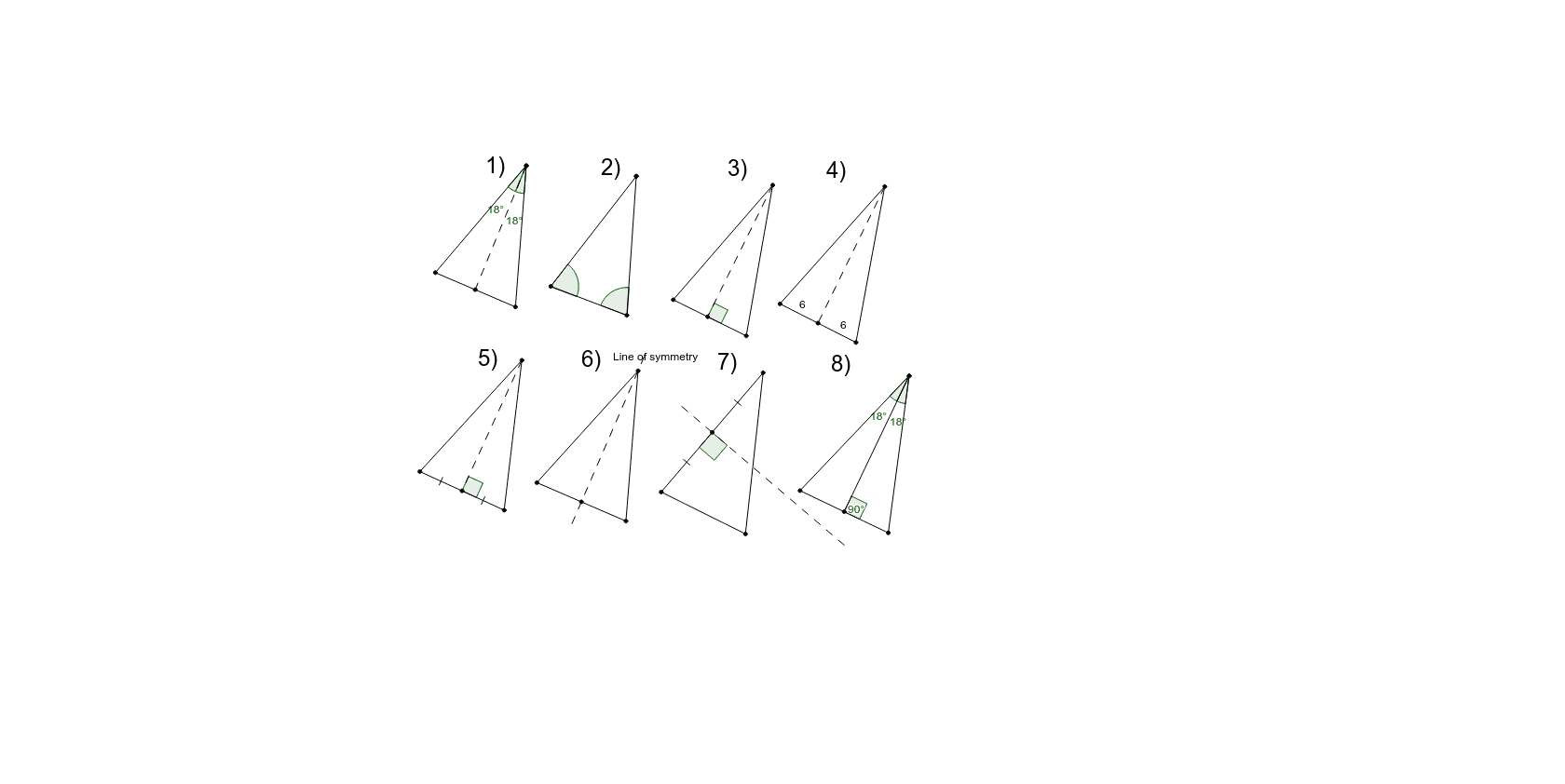
This example demonstrates the definition and properties of isosceles triangles by constructing examples and non-examples. It covers key mathematical concepts such as triangle properties, angles, and geometric construction. The construction uses GeoGebra commands like Rotate, Angle, Segment, Point, Ray, AngularBisector, Intersect, Mirror, OrthogonalLine, Midpoint, Circle, etc. Suitable for middle and high school students learning about isosceles triangles and geometric construction.
GeoGebra Commands & Parameters
Rotate(A, 36°, B) → A'Angle(A, B, A') → αSegment(C, D) → aRotate(C, α, D) → C'Rotate(D, α, D) → D'Segment(C', D') → a'Point(a') → ERay(D, E) → bPoint(b) → FSegment(C, F) → cAngularBisector(C, D, F) → dIntersect(d, c) → GSegment(D, G) → eSegment(D, F) → fAngle(C, D, G) → βAngle(G, D, F) → γSegment(H, I) → gSegment(H, J) → hMirror(H, g) → H'Mirror(J, g) → J'Segment(H', J') → h'Segment(J, J') → iAngle(J', J, H) → δAngle(H, J', J) → εSegment(K, L) → jSegment(L, M) → kSegment(M, K) → lOrthogonalLine(L, l) → mIntersect(m, l) → NSegment(L, N) → nAngle(M, N, L) → ζPoint(Circle[O, 2.5]) → PSegment(O, P) → pMidpoint(O, P) → QSegment(O, R) → qSegment(R, P) → rSegment(R, Q) → sSegment(S, T) → tMidpoint(S, T) → UOrthogonalLine(U, t) → a_1Point(a_1) → VSegment(S, V) → b_1Segment(V, T) → c_1Segment(V, U) → d_1Segment(W, Z) → e_1Midpoint(e_1) → A_1OrthogonalLine(A_1, e_1) → f_1Point(f_1) → B_1Segment(W, B_1) → g_1Segment(B_1, Z) → h_1Point(f_1) → C_1Point(f_1) → D_1Segment(C_1, D_1) → i_1Segment(E_1, F_1) → j_1Circle(G_1, 0.3) → k_1Midpoint(S, U) → H_1Point(k_1) → J_1Segment(G_1, J_1) → l_1Circle(H_1, l_1) → p_1OrthogonalLine(H_1, t) → m_1Intersect(p_1, m_1, 2) → K_1Intersect(p_1, m_1, 1) → L_1Segment(S, U) → q_1Segment(U, T) → r_1Midpoint(F_1, E_1) → I_1OrthogonalLine(I_1, j_1) → n_1Segment(F_1, I_1) → s_1Segment(I_1, E_1) → t_1Segment(E_1, M_1) → a_2Segment(M_1, F_1) → b_2Point(n_1) → N_1Point(n_1) → O_1Segment(N_1, O_1) → c_2Angle(F_1, I_1, O_1) → ηRotate(A_2, 36°, B_2) → A'_1Angle(A_2, B_2, A'_1) → α_1Segment(C_2, D_2) → a_3Rotate(C_2, α_1, D_2) → C'_1Rotate(D_2, α_1, D_2) → D'_1Segment(C'_1, D'_1) → a'_1Point(a'_1) → E_2Ray(D_2, E_2) → b_3Point(b_3) → F_2Segment(C_2, F_2) → c_3AngularBisector(C_2, D_2, F_2) → d_2Intersect(d_2, c_3) → G_2Segment(D_2, G_2) → e_2Segment(D_2, F_2) → f_2Angle(C_2, D_2, G_2) → β_1Angle(G_2, D_2, F_2) → γ_1OrthogonalLine(C_2, e_2) → g_2Intersect(g_2, f_2) → P_1Segment(D_2, P_1) → h_2Midpoint(C_2, P_1) → Q_1Segment(C_2, P_1) → i_2Segment(Q_1, D_2) → j_2Angle(P_1, Q_1, D_2) → θAngle(T, U, V) → ι