
Isosceles Triangle Base Angles Theorem Exploration
Loading the math board and drawing, please wait…
In collections
Properties of Polygons
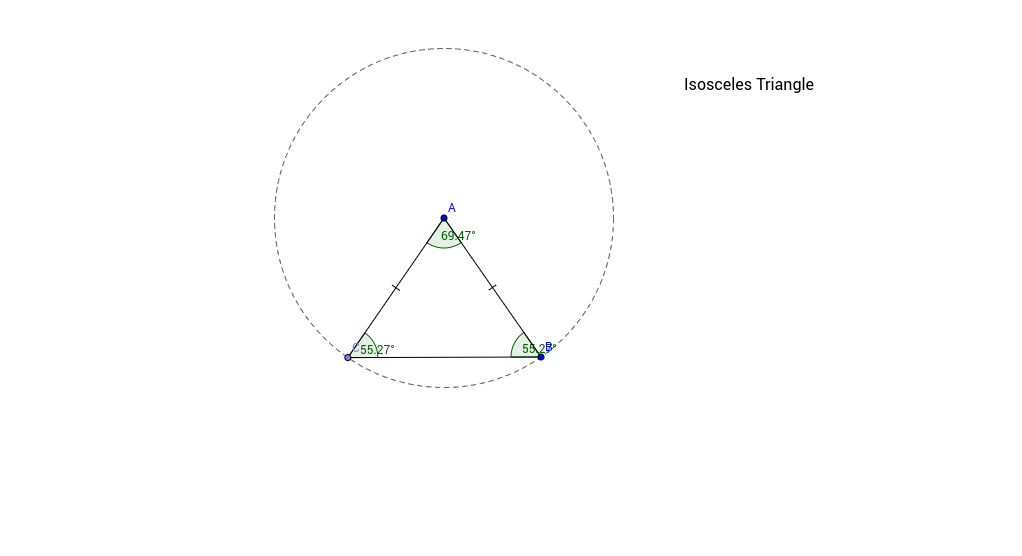
This GeoGebra example demonstrates that the base angles of an isosceles triangle are congruent. It involves core geometry concepts such as isosceles triangle properties, the base angles theorem, triangle congruence, and angle relationships. The construction uses GeoGebra commands Circle, Segment, Point, and Angle to generate points A, B, C, segments a, b, c, d, angles α, β, γ, and a text label text1. By constructing the triangle through circle intersections, students can interactively verify that angles opposite equal sides are equal. Suitable for middle school mathematics (grades 7–9) and introductory geometry courses, ideal for classroom demonstration or student-led discovery activities.
GeoGebra Commands & Parameters
Circle(A, B) → cSegment(A, B) → aPoint(c) → CSegment(A, C) → bSegment(C, B) → dAngle(A, B, C) → αAngle(B, C, A) → βAngle(C, A, B) → γ
AI Drawing Prompt Reference
Draw an isosceles triangle. The figure includes points A, B, C, and line segments a, b, d. Angles α, β, γ represent the interior angles. The key relationship is that the base angles of an isosceles triangle are equal, so α equals β. The construction order is: first draw a circle, then take a point C on the circle, then connect A to C and C to B, and finally label the segments and angles.
The prompt above was compiled from the original drawing commands and is for reference only.