
Isosceles Trapezoid Properties
Loading the math board and drawing, please wait…
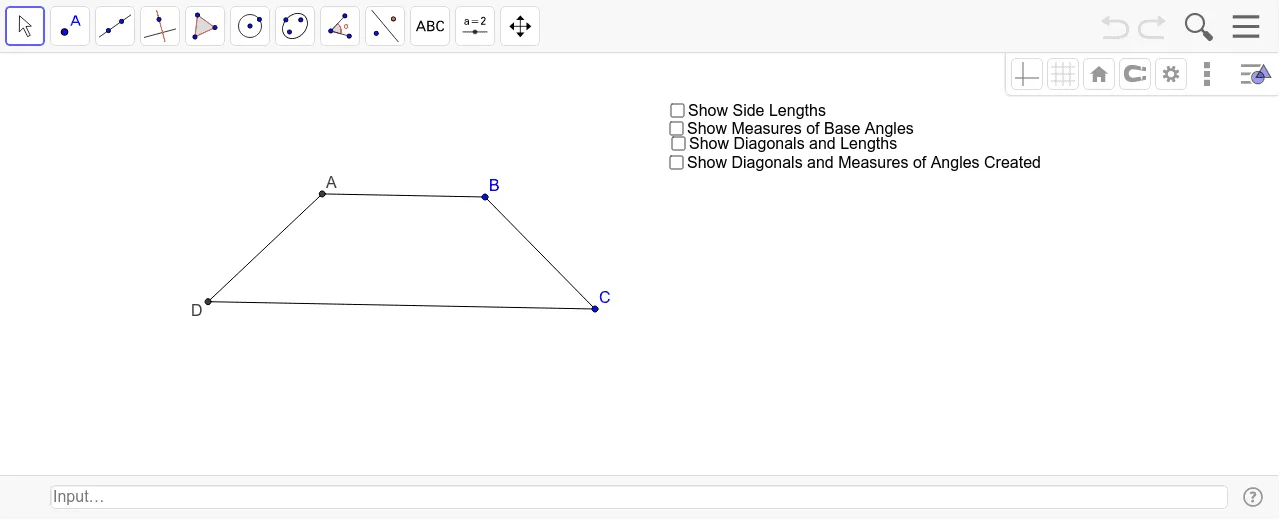
This example demonstrates the geometric properties of an isosceles trapezoid, including congruent diagonals and base angles. It involves commands like Circle, Line, Intersect, Segment, Distance, Midpoint, and Angle to construct the figure. Suitable for high school students to explore and verify theorems about isosceles trapezoids and enhance understanding of polygon properties.
GeoGebra Commands & Parameters
Circle(A_1, B) → cCircle(A_1, C) → dLine(A_1, B) → aLine(A_1, C) → bIntersect(c, b, 1) → ASegment(A, B) → eIntersect(d, a, 1) → DSegment(A, D) → fSegment(D, C) → gSegment(C, B) → hDistance(A, B) → distanceABMidpoint(A, B) →Distance(B, C) → distanceBCMidpoint(B, C) →Distance(C, D) → distanceCDMidpoint(C, D) →Distance(A, D) → distanceADMidpoint(A, D) →Angle(D, A, B) → αAngle(A, B, C) → βAngle(B, C, D) → γAngle(C, D, A) → δSegment(D, B) → kSegment(A, C) → lDistance(B, D) → distanceBDMidpoint(B, D) →Distance(A, C) → distanceACMidpoint(A, C) →Intersect(k, l) → EDistance(A, E) → distanceAEMidpoint(A, E) →Distance(B, E) → distanceBEMidpoint(B, E) →Distance(C, E) → distanceCEMidpoint(C, E) →Distance(D, E) → distanceDEMidpoint(D, E) →Segment(A, C) → nSegment(B, D) → pIntersect(n, p) → FAngle(A, F, B) → εAngle(B, F, C) → ζAngle(A, D, F) → ηAngle(F, D, C) → θAngle(D, A, F) → ιAngle(F, A, B) → κAngle(A, B, F) → λAngle(F, B, C) → μAngle(B, C, F) → νAngle(D, C, F) → ξ