
Isosceles Trapezoid Construction and Properties
Loading the math board and drawing, please wait…
In collections
Geometric Shapes
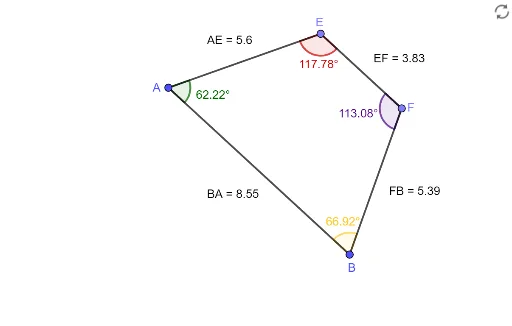
①This example demonstrates the complete geometric construction of an isosceles trapezoid, dynamically showing its symmetry, equal base angles, and equal diagonals. ②Core mathematical concepts include the definition of an isosceles trapezoid, properties of parallel lines, segment length relationships, angle equality, and precise construction using circles and perpendiculars. ③Construction highlights: from the summary, GeoGebra commands such as Segment, OrthogonalLine, Point, Intersect, Circle, Angle, and Distance are used to build the base, perpendiculars, intersection points, auxiliary circles, and to measure side lengths and angles, resulting in a labeled isosceles trapezoid. ④Suitable for middle school geometry or high school analytic geometry introduction, useful for classroom demonstration of trapezoid properties or as a hands-on construction exploration for students.
GeoGebra Commands & Parameters
Segment(A, B) → fOrthogonalLine(A, f) → gOrthogonalLine(B, f) → hPoint(g) → COrthogonalLine(C, g) → iIntersect(h, i) → DSegment(C, D) → jPoint(j) → EPoint(j) → FSegment(A, E) → kCircle(B, F) → cSegment(B, F) → lSegment(E, F) → mAngle(A, E, F) → αAngle(E, F, B) → βAngle(F, B, A) → γAngle(E, A, B) → δDistance(A, E) → distanceAEDistance(E, F) → distanceEFDistance(F, B) → distanceFBDistance(B, A) → distanceBA
AI Drawing Prompt Reference
Draw an isosceles trapezoid: start with a horizontal base segment. Construct perpendicular lines at both endpoints. Pick a point on one perpendicular as the top-left vertex, then draw a line through it perpendicular to that perpendicular, intersecting the other perpendicular to get the top-right vertex. Connect the top and bottom vertices to form the trapezoid. Choose two points on the top base, connect the left one to the bottom-left vertex, and draw a circle centered at the right one with radius equal to the distance to the bottom-right vertex. Finally, label the four interior angles and measure all four side lengths to verify equal legs, equal base angles, and equal diagonals.
The prompt above was compiled from the original drawing commands and is for reference only.