
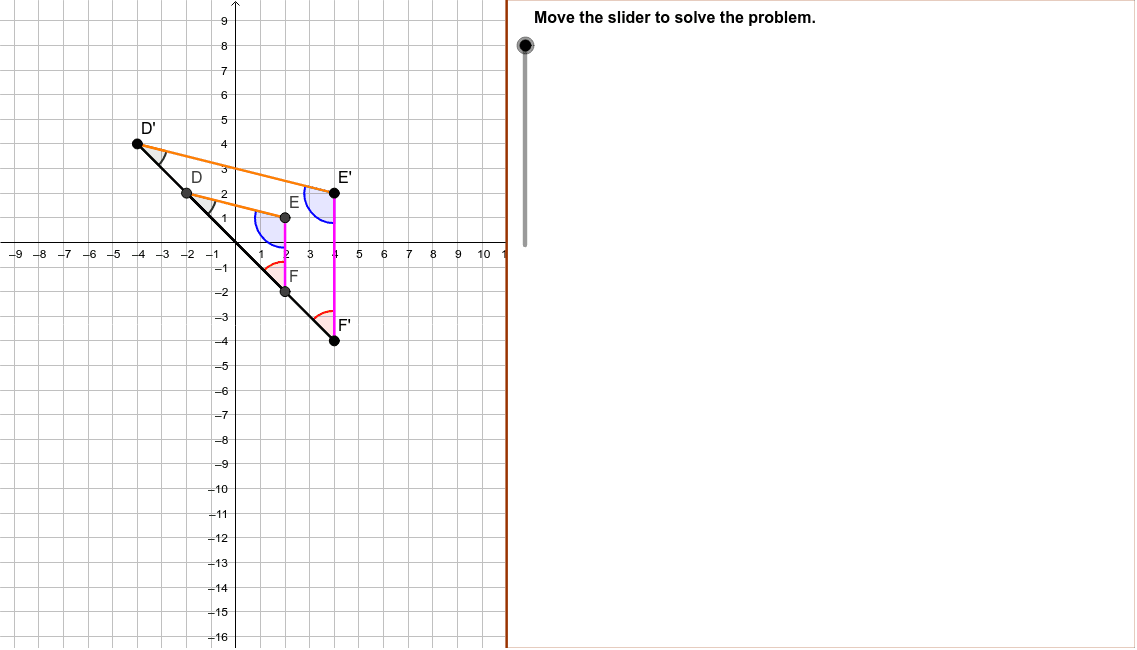
Is the transformation a dilation?
Loading the math board and drawing, please wait…
In collections
PARCC Math II Unit 5 Lesson 1
This example demonstrates how to determine if a geometric transformation is a dilation using GeoGebra. It involves core math concepts like the definition and properties of dilations, comparing angles and segment lengths. Construction highlights include commands like Intersect, Ray, Point, Polygon, Angle, Segment. Suitable for high school students learning about geometric transformations.
GeoGebra Commands & Parameters
Intersect(xAxis, yAxis) → OrRay(F, Or) → Ray1Point(Ray1) → DPolygon((11, y(Corner[1])), Corner[2], Corner[3], (11, y(Corner[4]))) → Mask, mask4, mask3, mask2, mask1Angle(E, F, D) → EFDAngle(F, D, E) → FDESegment(D, E) → DESegment(F, D) → DFSegment(F, E) → EFSegment(D', E') → D'E'Angle(E', F', D') → E'F'D'Segment(F', D') → D'F'Segment(E', F') → E'F'Angle(F', D', E') → F'D'E'Angle(D, E, F) → DEFAngle(D', E', F') → D'E'F'Ray(Or, E') → aRay(Or, F') → bRay(Or, D') → c
AI Drawing Prompt Reference
Draw a coordinate plane with the origin and a point on the positive x-axis. Draw a ray from the origin through the point labeled D. Mark a point E on the ray. Construct a quadrilateral with vertices at (11, y(Corner[1])), Corner[2], Corner[3], and (11, y(Corner[4])). Connect points D to E, D to F, and F to E. Then connect D' to E', D' to F', and E' to F'. Measure angles EFD, FDE, E'F'D', F'D'E', DEF, and D'E'F'. Finally, draw three rays through the origin parallel to the sides of angles E'F'D', F'D'E', and D'E'F'.
The prompt above was compiled from the original drawing commands and is for reference only.