
Investigation: Four Parallelogram Properties (Part 6)
Loading the math board and drawing, please wait…
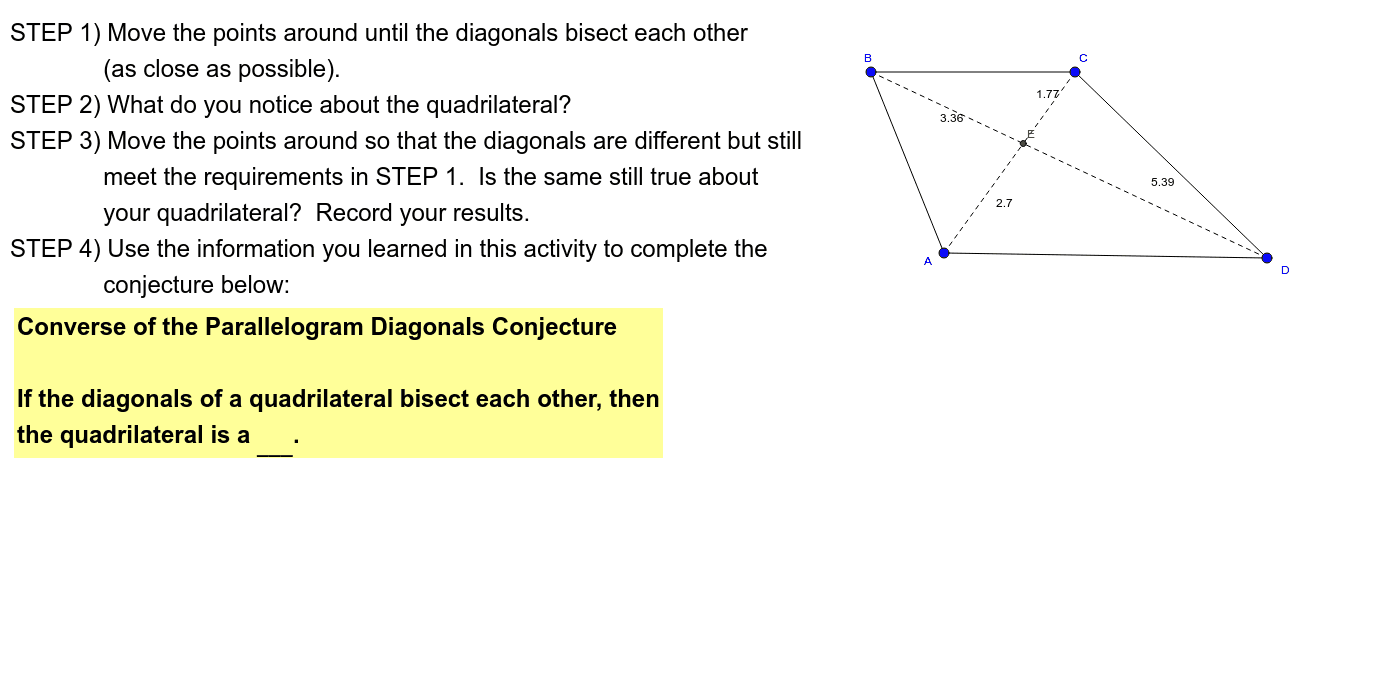
This example explores the type of quadrilateral with bisected diagonals by moving its vertices. Key mathematical concepts include quadrilateral properties and symmetry. It uses segment construction and intersection commands. Suitable for middle school and above students for geometric construction.
GeoGebra Commands & Parameters
Segment(A, B) → aSegment(B, C) → bSegment(C, D) → cSegment(D, A) → dSegment(B, D) → eSegment(A, C) → fIntersect(e, f) → ESegment(B, E) → gSegment(D, E) → hSegment(C, E) → iSegment(A, E) → j
AI Drawing Prompt Reference
Draw an arbitrary quadrilateral with four vertices connected by four sides. Then construct its two diagonals, which intersect at a single point. From this intersection point, draw four segments to each of the four vertices. The resulting figure shows the diagonals bisecting each other, forming four small triangles. The quadrilateral should be a parallelogram where diagonals bisect each other. Clearly display the intersection point and the segments from it to the vertices to observe symmetry and quadrilateral properties.
The prompt above was compiled from the original drawing commands and is for reference only.